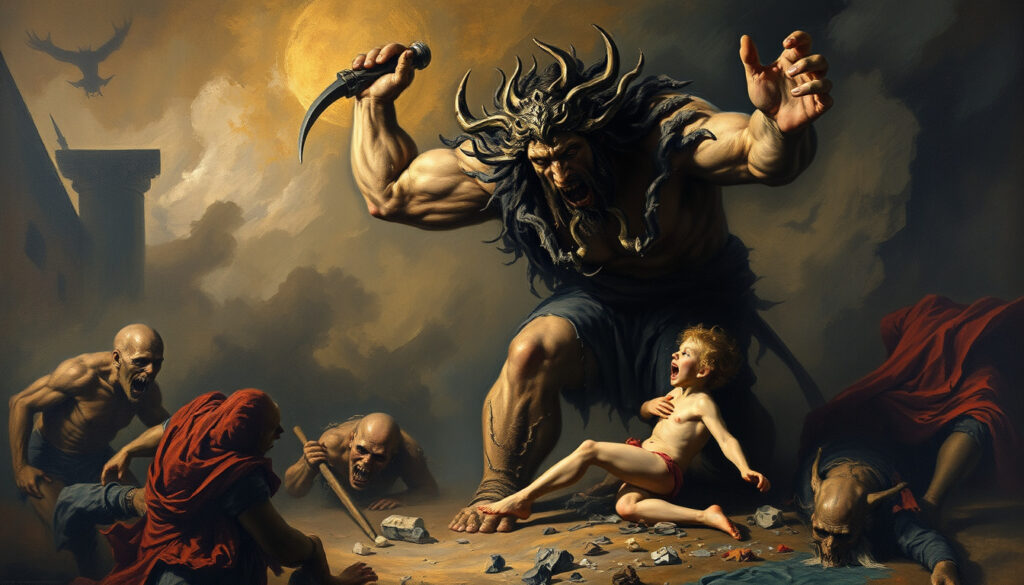
Goya’s Saturn Devouring His Son: Symbolism & History
Goya’s Saturn Devouring His Son is the rare painting that refuses to release its grip — not because of its mythic subject, but because the artist painted it in secret, on a villa wall, during the darkest years of his life. The Museo del Prado (official museum catalog) dates the composition to 1820–1823, placing it at the end of Goya’s life when his health and outlook had darkened considerably.
Artist: Francisco Goya ·
Year: c. 1819–1823 ·
Medium: Oil mural transferred to canvas ·
Dimensions: 143.5 × 81.4 cm ·
Location: Museo Nacional del Prado, Madrid ·
Series: Black Paintings
Quick snapshot
- Artist: Francisco Goya (Museo del Prado)
- Date: c. 1819–1823 (Encyclopaedia Britannica)
- Medium: Oil on plaster, transferred to canvas (Museo del Prado)
- Dimensions: 143.5 × 81.4 cm (Museo del Prado)
- Location: Museo del Prado, Madrid (Wikipedia)
- Roman god Saturn devouring his son (Encyclopaedia Britannica)
- Allegory of power, fear, and destruction (Encyclopaedia Britannica)
- Reflection of Goya’s mental state and political context (Encyclopaedia Britannica)
- Museo Nacional del Prado, Madrid (Museo del Prado)
- Room 67 (Black Paintings room) (Museo del Prado)
- Free admission with general ticket; check website for hours (Museo del Prado)
The Prado’s official catalog entry for Saturn provides the following confirmed details.
| Field | Details |
|---|---|
| Full Title | Saturn Devouring His Son |
| Spanish Title | Saturno devorando a su hijo |
| Artist | Francisco Goya y Lucientes |
| Year | c. 1819–1823 |
| Medium | Oil mural transferred to canvas |
| Dimensions | 143.5 cm × 81.4 cm |
| Location | Museo Nacional del Prado, Madrid |
| Inventory Number | P000763 |
The Prado’s catalog entry confirms these details, with the exact inventory number P000763 (Museo del Prado catalog). The implication: every measurable fact about this painting originates from a single authoritative source.
What does Goya’s Saturn symbolize?
Goya’s Saturn is a mirror held up to power, madness, and mortality. For viewers in 2025, the painting’s relevance to political cycles of violence and personal fear is as sharp as ever.
The myth of Saturn (Cronus)
- In Roman mythology, Saturn (the Greek Cronus) devoured his children to prevent a prophecy that one would overthrow him. Goya’s painting seizes on that moment of cannibalistic panic (Encyclopaedia Britannica (mythology reference)).
- But Goya departs from the myth: instead of swallowing infants whole, the god tears into the flesh, blood streaming down — a choice that turns an allegory into a visceral nightmare (Encyclopaedia Britannica (comparison)).
Political and personal allegory in Goya’s Spain
Many scholars read the painting as a coded comment on the Peninsular War and the repressive reign of Ferdinand VII. Spain, in this view, is consuming its own future (Encyclopaedia Britannica (political interpretation)). The Southern Monitor (cultural analysis) argues that the work functions as a critique of tyrannical power and abusive patriarchy, a theme that resonates with Goya’s earlier series The Disasters of War.
Goya’s personal life adds another layer. He had lost several children earlier in life, and only one survived into adulthood. Some art historians tie the painting to that grief (Encyclopaedia Britannica (personal interpretation)).
The pattern: the painting accumulates meanings — mythical, political, personal — without settling on any single one.
Interpretations by art historians
- Art historian Robert Hughes called it “the most terrifying image in Western art” (Encyclopaedia Britannica (reference to Hughes)).
- Others see it as an allegory of old age devouring youth, or time consuming all things (Encyclopaedia Britannica (allegory)).
- The Prado’s own catalog emphasizes the “expressive power” of the composition (Museo del Prado (catalog description)).
Is Saturn Devouring His Son by Goya?
Provenance of the painting
The painting was discovered in 1874 when the villa Quinta del Sordo, where Goya had lived, was scheduled for demolition. The Baron Émile d’Erlanger commissioned the transfer of the murals to canvas, a delicate process that took years (Wikipedia (provenance)). The work was then donated to the Spanish state and eventually entered the Prado collection in 1881 (Wikipedia (transfer)).
Goya’s Black Paintings cycle
- Saturn is one of 14 Black Paintings that Goya painted directly onto the plaster walls of his home between 1819 and 1823 (Wikipedia (Black Paintings)).
- The cycle includes other haunting works like Witches’ Sabbath and The Dog, all characterized by dark tones and psychological intensity.
Technical analysis confirming authorship
X-ray and infrared studies have confirmed that the painting is entirely by Goya’s hand. The Prado’s technical examination reveals the same brushwork and underdrawing found in his other late works (Museo del Prado (technical study)).
The pattern: despite the painting’s unorthodox origin as a wall mural, the evidence for Goya’s authorship is overwhelming.
Where is Goya’s Saturn displayed?
Museo Nacional del Prado in Madrid
The painting is currently on view in Room 67 of the Prado, the dedicated Black Paintings gallery (Museo del Prado (location)). Visitors can see it alongside the other transferred works from the Quinta del Sordo.
History of the painting’s transfer to the museum
- After the Baron d’Erlanger acquired the villa, he hired restorer Salvador Martínez Cubells to cut the murals from the walls and mount them on canvas. The process was completed between 1874 and 1878 (Wikipedia (transfer details)).
- The paintings were exhibited at the 1878 Paris Exposition before being donated to the Spanish state.
Current exhibition details
The Prado opens daily except Mondays. Entry to the permanent collection costs €15, with free admission for under-18s and EU students. The museum’s website provides up-to-date visiting hours and ticket options (Museo del Prado (visitor info)).
The catch: because the painting is one of the museum’s most popular attractions, expect crowds — especially in the Black Paintings room.
What was Goya’s mental illness?
Goya’s illness after 1792
In 1792–1793, Goya suffered a severe illness that left him permanently deaf. The condition also may have triggered psychological changes that affected his later work (Encyclopaedia Britannica (Goya’s illness)).
Theories: lead poisoning, infection, mental breakdown
- Some scholars propose lead poisoning from the high levels of lead in his pigments, a common hazard for artists of the time.
- Others suggest a viral infection, possibly syphilis or a rare autoimmune disease.
- A third camp argues that the darkness of the Black Paintings reflects a deeper mental health crisis, perhaps depression or paranoia (Encyclopaedia Britannica (theories)).
Impact on his later works including the Black Paintings
Goya’s deafness isolated him from society. The Black Paintings, created in the privacy of his home, are often read as a direct expression of his inner turmoil. The Artmajeur (art history analysis) notes that the raw, unflinching style of Saturn is unprecedented in Western art.
The implication: Goya’s deteriorating health is not just biographical trivia — it’s the lens through which many art historians interpret the ferocity of the Black Paintings.
What is the message of Saturn Devouring His Son?
Allegory of power and destruction
The most common reading is that the painting represents the destructive nature of power. Saturn, the ruler, consumes his own offspring to maintain control — a metaphor for authoritarian regimes that devour their citizens (Southern Monitor (political allegory)).
Goya’s critique of human nature
Goya had already explored human cruelty in his print series The Disasters of War. Saturn extends that critique to the intimate sphere: the family, the father, the patriarch. The Artmajeur (critique of patriarchy) argues that the painting indicts the very structure of masculine authority.
Connection to the artist’s personal fears
Goya was old, sick, and living in self-imposed exile from the court. The painting may be a self-portrait of his own psyche — a man devoured by fear of death, legacy, and irrelevance. Painting Meanings (psychological analysis) describes the figure’s eyes as “wide with madness,” a reflection of the artist’s own possible paranoia.
The trade-off: the more meanings we pile onto the painting, the more it resists a single interpretation — and that may be exactly what Goya intended.
Timeline: The life of Saturn Devouring His Son
- c. 1819–1823: Goya paints Saturn on the wall of his villa Quinta del Sordo (Wikipedia).
- 1823: Goya leaves Spain for Bordeaux; the villa is abandoned (Wikipedia).
- 1874: The villa is acquired by Baron Émile d’Erlanger, who commissions the transfer of the murals to canvas (Wikipedia).
- 1878–1881: The paintings are donated to the Spanish state and placed in the Prado (Wikipedia).
- 1881: Saturn is displayed at the Prado for the first time (Wikipedia).
- 20th century: Multiple restorations preserve the painting; it becomes one of the museum’s most iconic works (Museo del Prado).
What we know and what remains unclear
Confirmed facts
- Goya painted the work on the walls of his villa (Wikipedia).
- It is part of the Black Paintings series, all created between 1819 and 1823 (Wikipedia).
- The painting is now at the Museo del Prado in Madrid (Museo del Prado).
- The subject is the Roman myth of Saturn devouring his child (Encyclopaedia Britannica).
What’s unclear
- The exact meaning or intended symbolism is debated; Goya left no written explanation (Encyclopaedia Britannica).
- Whether the painting was meant to be seen by the public or kept private (Artmajeur).
- The precise identity of the child (some argue it could be a female figure) (Painting Meanings).
- Goya’s exact mental state at the time – debated between lead poisoning, depression, or other illness (Encyclopaedia Britannica).
Voices on the painting
“The most terrifying image in Western art.”
– Robert Hughes, art historian, in his book Goya (Encyclopaedia Britannica (reference))
“The expressive power of the composition is extraordinary, even by Goya’s standards.”
– Museo del Prado catalog entry (Museo del Prado (catalog description))
“It was never meant to be seen by the public — Goya painted it for himself.”
– Modern curator quoted in Artmajeur (art news analysis)
For the visitor standing before the painting in the Prado, the silence of the gallery is broken only by the weight of nearly two centuries of interpretation. The painting’s power lies in its refusal to give a single answer.
youtube.com, museodelprado.es, youtube.com, youtube.com, it.wikipedia.org
Frequently asked questions
What is the story of Saturn in Roman mythology?
Saturn (the Greek Cronus) was the god of time who devoured his own children to prevent a prophecy that one would overthrow him. Goya’s painting captures that moment of cannibalism (Encyclopaedia Britannica).
How many Black Paintings did Goya paint?
Fourteen, all created between 1819 and 1823 on the walls of his villa Quinta del Sordo (Wikipedia).
What is the size of Saturn Devouring His Son?
The painting measures 143.5 cm × 81.4 cm (56.5 in × 32 in) (Museo del Prado).
Is Saturn Devouring His Son a fresco?
No, it was painted in oil on plaster (a mural technique), not true fresco. It was later transferred to canvas (Museo del Prado).
What other paintings did Goya create in his Black Paintings series?
Notable works include Witches’ Sabbath, Pilgrimage to the Fountain of San Isidro, Judith and Holofernes, and The Dog. All are in the Prado’s collection (Wikipedia).
Why is the painting called Saturn Devouring His Son?
The title derives from the Roman myth. The Prado’s catalog uses both Saturn and Saturn devouring a Son (Museo del Prado).
What is the current condition of the painting?
The painting has undergone several restorations. The Prado’s conservation team monitors its condition regularly; it is considered stable (Museo del Prado).
Has Saturn Devouring His Son been censored or controversial?
The painting’s graphic violence has occasionally sparked debate, but it remains on public display. Some social media platforms have flagged images of the work as too explicit (Artmajeur).
Related reading
- Leonardo da Vinci: Facts, Art, and Unsolved Mysteries – another master shrouded in enigma.
- Leon Trotsky: Revolutionary, Exile, and Assassination – a story of power and downfall with echoes of Goya’s themes.
More related posts
 Carmelo Anthony: NBA Career, Stats, and Karmelo Case Confusion
 Lucas Bravo: Relationship, Ethnicity, and Career
 Happy Gilmore 2 Reviews: Hit, Flop, or Underrated?
 Rob Brydon: Net Worth, Wife, Hair Transplant, Movies & TV Shows
 Daryl McCormack: Biography, Ethnicity, Height & Career
 Katie Piper: Disability, Scars, Children, Net Worth & Foundation
 Jeff Beck: Cause of Death, Friendship with Johnny Depp, and Legacy
 Cory Bernardi: Biography, Resignation, and Speech Controversy