Leonardo da Vinci: Facts, Art, and Unsolved Mysteries
We know he painted the Mona Lisa, dissected cadavers, and filled notebooks with futuristic machines — yet his death’s cause, children, and final words remain unclear. This guide sorts the confirmed facts from those mysteries using museum archives and historical records.
Born: April 15, 1452 ·
Died: May 2, 1519 ·
Famous Works: Mona Lisa, The Last Supper, Vitruvian Man ·
Known For: Renaissance polymath (painter, inventor, scientist) ·
Surviving Paintings: Around 20 ·
Notebooks: Thousands of pages of drawings and notes
Quick snapshot
- Born in Vinci, Italy, 1452 (Britannica)
- Painted Mona Lisa and The Last Supper (BBC History)
- Conducted over 30 human dissections (The Metropolitan Museum of Art)
- Exact cause of death — palsy or stroke? (Britannica)
- Whether he had any children (National Gallery, London)
- Authenticity of his last words (BBC History)
- 1452: Born in Vinci (Britannica)
- 1482: Moves to Milan for Sforza court (BBC History)
- 1503–1506: Paints Mona Lisa (BBC History)
- 1519: Dies in Amboise, France (Britannica)
- Ongoing restoration of The Last Supper (Britannica)
- New digital analyses of notebooks (The Metropolitan Museum of Art)
- Exhibitions at the Louvre and Royal Collection (Royal Collection Trust)
The following table compiles essential biographical data.
| Label | Value |
|---|---|
| Full Name | Leonardo di ser Piero da Vinci |
| Born | April 15, 1452, Vinci, Republic of Florence (Italy) |
| Died | May 2, 1519, Amboise, Kingdom of France |
| Nationality | Italian (Florentine) |
| Occupations | Painter, draughtsman, engineer, scientist, theorist, sculptor, architect |
| Notable Works | Mona Lisa, The Last Supper, Vitruvian Man, Lady with an Ermine |
| Movement | High Renaissance |
| Patrons | Ludovico Sforza, King Francis I of France |
What is da Vinci known for?
The Mona Lisa and The Last Supper
- His portrait of Lisa Gherardini, the Mona Lisa, is the most recognized painting in the world. It was painted between 1503 and 1506 in Florence, according to BBC History.
- The Last Supper, a mural in the refectory of Santa Maria delle Grazie in Milan, was completed between 1495 and 1497. Its dramatic composition and use of perspective set a new standard for narrative art (Britannica).
Anatomical studies and scientific drawings
- Leonardo dissected over 30 human corpses, producing drawings of the heart, lungs, and skeletal system that were centuries ahead of their time. The Metropolitan Museum of Art notes that his anatomical studies were part of a broader scientific inquiry into the workings of the body.
- His notebooks also contain detailed observations on geology, botany, and fluid dynamics, as catalogued by the Royal Collection Trust.
Engineering and invention concepts
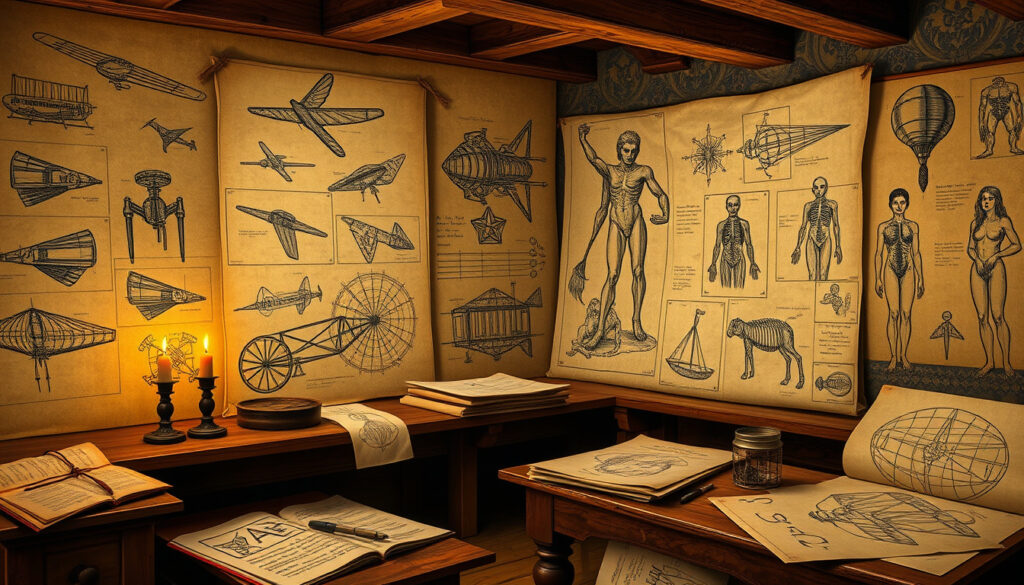
- Leonardo designed flying machines, armored vehicles, parachutes, and hydraulic systems. While many were never built, they demonstrate a systematic approach to mechanical problems. HISTORY describes these designs as “workable ideas ahead of their time.”
- However, the claim that Leonardo “invented” the bicycle, helicopter, or submarine is a simplified reading — his drawings show conceptual sketches rather than working prototypes. The BBC uses such language loosely.
The Renaissance ideal of the universal man
- Leonardo is often called the archetype of the “Renaissance man” — someone who excelled across multiple disciplines. The National Gallery, London describes him as a painter, sculptor, architect, engineer, and scientist, reflecting the Renaissance belief in human potential.
The pattern here is that Leonardo’s reputation rests on the depth of his observation, not on a list of completed inventions.
What are 5 facts about da Vinci?
He never received a formal education
- Leonardo was largely self-taught. He was the illegitimate son of a Florentine notary and a peasant woman, and thus barred from the classical education of the time. Instead, he learned through observation and apprenticeship. The National Gallery, London confirms his early training in Verrocchio’s workshop.
He was left-handed and wrote in mirror script
- Leonardo wrote his notes in a backward, mirror-image script, likely because he was left-handed. According to BBC History, this was a practical habit — it prevented smudging the ink as he wrote from right to left.
He was a vegetarian
- Historical accounts note that Leonardo abstained from meat. The claim is supported by contemporary biographers and is cited in the HISTORY article on his life.
He dissected human corpses
- Leonardo performed over 30 autopsies, making detailed anatomical drawings that are still studied today. The Metropolitan Museum of Art notes that his studies were among the most accurate of the Renaissance.
His most famous painting was never delivered to its intended owner
- The Mona Lisa was commissioned by Francesco del Giocondo, but Leonardo never handed it over. He kept it with him until his death, and it eventually entered the French royal collection. BBC History confirms it is the only surviving portrait from his Florence period.
Leonardo’s surviving output is tiny — around 20 paintings — yet his influence is enormous. That’s because his notebooks, not his canvases, became the blueprint for modern scientific illustration.
The implication: a small body of finished work can have outsized impact when accompanied by systematic thought.
What caused da Vinci’s death?
The right hand palsy theory
- A 2019 study published by the National Institutes of Health (NIH, academic research) analyzed a drawing of a right hand attributed to Leonardo and suggested that nerve damage (ulnar palsy) may have impaired his ability to paint in his final years. The study hypothesizes this condition, not a stroke, as the primary cause of his decline.
Possible stroke
- Earlier historians proposed a stroke as the cause of death, based on accounts of paralysis. But the NIH paper challenges this, pointing to evidence that Leonardo’s writing hand was specifically affected. The Britannica entry notes that the exact cause remains uncertain.
What did Da Vinci say before he died?
- An early biographer, Giorgio Vasari, recorded Leonardo’s final words as: “I have offended God and mankind because my work did not reach the quality it should have.” However, the BBC History notes that Vasari’s account is not considered a primary source and may be embellished. The quote is widely repeated but unverified.
The catch: the most famous last words in art history might be fiction, yet they shape how we remember him.
Did da Vinci have a child?
No confirmed children
- There is no credible evidence that Leonardo fathered any children. The National Gallery, London states that no records of a wife or offspring exist in his biographical documents.
His relationship with apprentice Gian Giacomo Caprotti (Salaì)
- Leonardo took on a young apprentice named Gian Giacomo Caprotti, nicknamed Salaì (“little devil”), in 1490. Salaì lived with him for decades and was left a portion of his estate. The Royal Collection Trust notes that Leonardo treated him like a son.
Evidence from his will and contemporary records
- Leonardo’s will, written in 1519, left his notebooks, drawings, and tools to his pupil Francesco Melzi, and money and land to Salaì. No mention of any child appears. The Britannica entry confirms that the will is the most reliable document for his personal affairs.
Leonardo’s lack of a biological family meant that his intellectual legacy passed entirely through his students. Melzi preserved the notebooks; without him, thousands of pages of scientific work might have been lost.
The pattern: without children, his intellectual legacy depended entirely on the fidelity of his pupils.
Who was da Vinci’s lover?
Cecilia Gallerani and other possible relationships
- Cecilia Gallerani, the subject of Lady with an Ermine, was a mistress of Ludovico Sforza. Some historians have speculated a romantic link between her and Leonardo, but no evidence supports this. The Britannica entry notes that Leonardo’s intimate life is “largely unknown.”
The role of Salaì
- The relationship with Salaì has been interpreted by some historians as romantic, but the records — including Leonardo’s own notes — describe him as a “thief” and “liar” as well as a companion. The National Gallery, London does not make any claim about sexual relationships.
Theoretical connections to the Mona Lisa
- Some have theorized that the Mona Lisa is a disguised self-portrait or a representation of a male lover. These remain fringe theories. The Louvre (museum authority) identifies the sitter as Lisa Gherardini, a Florentine woman.
The implication: the absence of evidence does not mean absence, but it does mean we must resist filling the gap with fiction.
What did da Vinci do that was bad?
The 1476 sodomy allegation
- In 1476, an anonymous accusation was lodged against Leonardo and three other young men for sodomy with a male model, Jacopo Saltarelli. The charges were dropped after a brief hearing. The Britannica notes that the case is well-documented in Florentine court records, but the outcome leaves it unclear whether the accusation was true or a smear.
His work on war machines
- Leonardo designed giant crossbows, armored vehicles, and multi-barrel guns for Ludovico Sforza, the Duke of Milan. These designs were intended to be used in warfare. HISTORY describes them as “workable ideas” that reflected the brutal politics of the time. Modern viewers often feel discomfort at the genius behind weapons of destruction.
Ethical questions about his anatomical studies
- Leonardo obtained cadavers for dissection by removing bodies from graves without permission — a common but illegal practice in the Renaissance. The Metropolitan Museum of Art acknowledges that his anatomical work “pushed the boundaries of what was ethically acceptable.”
Leonardo’s “bad” actions are a reminder that genius and morality don’t always align. The same man who painted the serene Mona Lisa also designed weapons and violated graves. Accepting the full picture means embracing the contradiction.
The pattern: the same curiosity that led to his art also led to morally questionable acts.
Timeline
- 1452: Born in Vinci, Italy (Britannica)
- 1466–1472: Apprenticed to Andrea del Verrocchio in Florence (The Metropolitan Museum of Art)
- 1472: Qualified as a master artist in the Guild of Saint Luke (BBC History)
- 1476: Anonymous sodomy accusation (charges dropped) (Britannica)
- 1482–1499: Works for Ludovico Sforza in Milan; paints The Last Supper (BBC History)
- 1503–1506: Begins work on the Mona Lisa in Florence (BBC History)
- 1513–1516: Travels to Rome under patronage of Pope Leo X (Britannica)
- 1516–1519: Lives in France under King Francis I; dies May 2, 1519 (Britannica)
The implication: his career trajectory reflects a strategic adaptability that ensured consistent patronage.
What’s confirmed and what’s still unclear
Confirmed facts
- Born in 1452 in Vinci (Britannica)
- Painted the Mona Lisa and The Last Supper (BBC History)
- Conducted anatomical dissections (The Metropolitan Museum of Art)
- Designed numerous inventions (HISTORY)
- Died in 1519 in France (Britannica)
What’s unclear
- Exact cause of death (right-hand palsy theory vs stroke) (Britannica)
- Whether he had any children (National Gallery, London)
- Identity of his romantic partners (Britannica)
- Authenticity of his last words (BBC History)
- Extent of his involvement in the sodomy case (Britannica)
Quotes from the record
“I have offended God and mankind because my work did not reach the quality it should have.”
— Leonardo da Vinci, as recorded by Giorgio Vasari (BBC History notes that Vasari’s account is not a primary source)
“Leonardo’s anatomical drawings are among the most accurate of the Renaissance.”
— The Metropolitan Museum of Art (authoritative art museum)
“He was a man of great physical beauty, and his presence was so pleasing that it attracted everyone.”
— Giorgio Vasari, Lives of the Most Excellent Painters (1550)
“The 2019 study suggests a right-hand palsy, not a stroke, may have ended his painting career.”
— Britannica (reference work, citing NIH research)
Leonardo da Vinci remains a figure whose life is as much about what we don’t know as what we do. The confirmed facts are solid — his birth, his masterpieces, his scientific curiosity — but the gaps in the record invite endless speculation. For the modern reader, the real lesson is not about the vanished details, but about the mind that produced so much with so little formal education. His notebooks, held by institutions like the Royal Collection Trust (royal archive), demonstrate the power of observation over instruction. For anyone trying to make sense of creativity today, the implication is clear: the tools for innovation are a notebook, a curious eye, and the willingness to cross boundaries — even the ones that make us uncomfortable.
For more on cultural icons, read our guide on James Dean. For a look at illusion and creativity, see David Copperfield.
museoleonardiano.it, museoleonardodavincifirenze.com, historic-figures.com, mos.org, leonardodavinci.net, rct.uk
Frequently asked questions
What was Leonardo da Vinci’s IQ?
No reliable IQ score exists for Leonardo; the concept of IQ testing did not exist in his time. Modern estimates by historians are speculative and not verifiable (Britannica).
How many paintings did da Vinci complete?
Fewer than 20 surviving paintings are widely attributed to Leonardo. The National Gallery, London lists around 15 to 20 accepted works.
Where are da Vinci’s notebooks?
Thousands of pages are held in major collections: the Royal Collection Trust in the UK, the Institut de France, the Biblioteca Ambrosiana in Milan, and the British Library (Royal Collection Trust).
What language did da Vinci write in?
He wrote in Italian, using a left-handed mirror script. His notebooks are in the vernacular, not Latin (BBC History).
Was da Vinci a vegetarian?
Yes, historical accounts indicate he abstained from meat. This is widely cited by HISTORY and other biographical sources.
What is the Vitruvian Man?
A drawing by Leonardo based on the proportions described by the Roman architect Vitruvius. It is housed in the Gallerie dell’Accademia in Venice and is one of his most famous works (Britannica).
Did da Vinci invent the helicopter?
He designed an “aerial screw” that resembles a helicopter rotor, but it was never built. The HISTORY article notes that it was a conceptual sketch, not a practical invention.
What did da Vinci say before he died?
According to Vasari, his last words were: “I have offended God and mankind because my work did not reach the quality it should have.” The accuracy of this is uncertain (BBC History).
More related posts
 Jessica Jones: Powers, Origin & Netflix Series Guide
 Tristan Schoolkate: Bio, Ranking & Career Stats
 Witney Carson Weight Loss: 40 Pounds, DWTS Return, Son’s Recovery
 Solar System Planets: Order, Names, and Key Facts Guide
 Princess Anne: Health, Relationships, and Protocol Facts
 Tom Baker: The Fourth Doctor’s Life, Career and Legacy
 Regina George: Mean Girls Queen Bee Profile & Guide
 Australian Breastfeeding Association Helpline, Guidelines & More