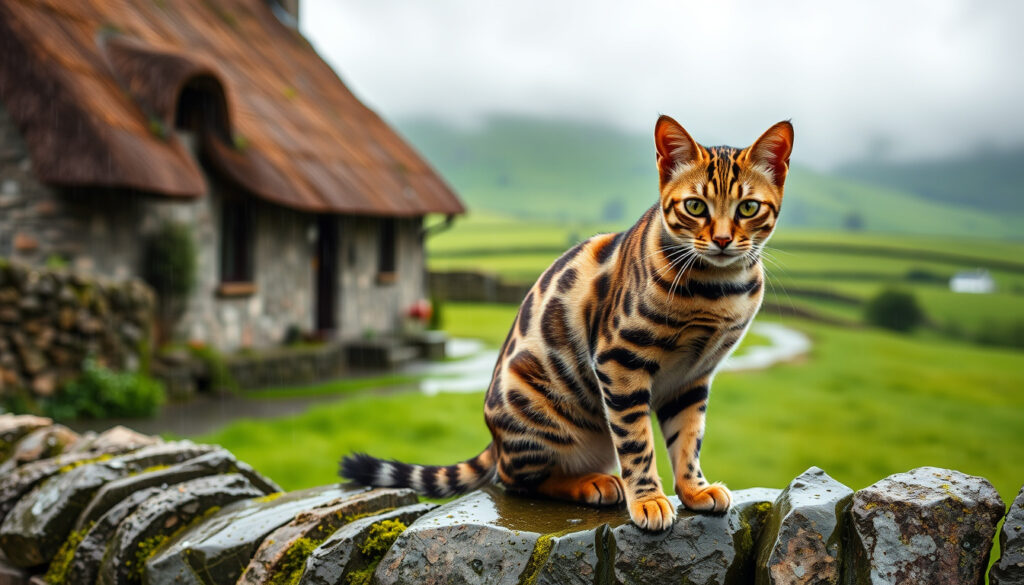
Bengal Cat Guide: Cost, Temperament & Downsides in Ireland
Bengal cats look like they walked out of a jungle, but they’re designed to live in your living room. That wild appearance comes with a personality that’s far from the typical sofa-loving lap cat. If you’re in Ireland and thinking about bringing one home, this guide walks through the real costs, temperament, and what it actually takes to keep a Bengal happy.
Average Lifespan: 12–16 years ·
Weight Range: 4–7 kg (males) ·
Cost in Ireland: €600 – €3,000 ·
Activity Level: Very high ·
Temperament: Active, curious, talkative
Quick snapshot
- Active and playful (Petplan – pet insurance provider)
- Independent, not a lap cat (PetMD – veterinary resource)
- Highly intelligent (Vets Love Pets – veterinary guide)
- Lots of exercise and enrichment (Vets Love Pets – veterinary guide)
- Balanced diet with high protein (Vets Love Pets – veterinary guide)
- Regular grooming – low shedding (Vets Love Pets – veterinary guide)
- Purchase price €600–€3,000 (Pet Sitters Ireland – pet care resource)
- Monthly food and supplies €50–€100 (Pet Sitters Ireland – pet care resource)
- Vet bills similar to other breeds (Pet Sitters Ireland – pet care resource)
- Best for experienced owners
- Not ideal for small apartments
- Needs secure outdoor access or catio
Six key facts, one pattern: the Bengal is a hybrid with wild ancestry, built for action, not cuddles.
| Fact | Value |
|---|---|
| Scientific name | Felis catus (hybrid) |
| Origin | United States (1960s) |
| Coat | Short, dense, spotted or marbled |
| Average height | 30–40 cm at shoulder |
| Temperament | Active, curious, vocal |
| Grooming needs | Low – weekly brushing |
Are Bengal house cats good pets?
The short answer: yes, but only if you’re ready for a high-energy, intelligent animal that doesn’t behave like a typical domestic cat. Bengals are Petplan (pet insurance provider) describes them as “energetic, playful, intelligent, curious, and highly active.” That’s not marketing fluff — it’s a daily reality.
What are the downsides of Bengal cats?
- Destruction when bored – they scratch furniture and climb curtains without enough stimulation (Australianbrief.org – Ireland guide).
- Noise – they’re vocal, with chirps and meows that demand attention (Vets Love Pets – veterinary guide).
- High prey drive – small animals like rabbits or hamsters are at risk (Pet Sitters Ireland – pet care resource).
- Not a lap cat – they show affection on their own terms, not yours (PetMD – veterinary resource).
Why do Bengal cats hate being picked up?
Their wild hybrid ancestry makes them more independent and less tolerant of restraint. PetMD (veterinary resource) notes that Bengals are not the right choice for owners wanting a “quiet, low-maintenance lap cat.” Early socialization can improve tolerance, but it does not guarantee cuddliness.
How much exercise does a Bengal cat need?
Daily play sessions with interactive toys, puzzle feeders, and climbing structures. Vets Love Pets (veterinary guide) states they need “substantial daily interaction, enrichment, and mental stimulation.” Without it, expect trouble.
A Bengal owner in Ireland must replace a typical cat’s nap time with active playtime. If you work long hours away from home, this breed will likely test your patience — and your furniture.
The implication: Bengal cats are not beginner pets. They demand time, space, and an owner who understands that “pet” doesn’t mean “couch ornament.”
How much does a Bengal cat cost in Ireland?
Price is the first shock for most Irish buyers. Pet Sitters Ireland (pet care resource) reports Bengal kitten prices commonly around €400–€700, while reputable breeders with pedigree registration charge €800–€2,500. A separate PoPlix.uk (Ireland guide) summary puts the range at €600–€3,000. A live DoneDeal (Irish classifieds) listing showed a Bengal at €1,000.
Where to find Bengal kittens for sale in Ireland
Registered breeders are the safest route. The Pet Sitters Ireland guide recommends buying from a registered breeder to avoid health issues. Classifieds on DoneDeal and Facebook groups exist, but buyer beware — no pedigree, no health guarantees.
What affects the price of a Bengal cat?
- Pedigree and registration – GCCF or TICA papers add value.
- Coat pattern – rare rosettes or marbling cost more.
- Breeder reputation – established breeders charge premium for health screening.
- Generation – F1–F3 (closer to wild) are more expensive and often restricted.
Are there Bengal cat rescues in Ireland?
Adoption is rare but possible. Breed-specific rescues exist in the UK, and some cats appear on Irish animal welfare sites. Pet Sitters Ireland notes that adoption is uncommon because Bengals are still relatively new to the country.
For a buyer in Ireland, the real cost isn’t just the purchase price — it’s the monthly enrichment, higher-quality food, and potential vet bills that come with a breed prone to genetic conditions like hypertrophic cardiomyopathy (PetPlace – pet health resource).
What this means: budget at least €1,000 upfront for a well-bred kitten, plus €50–€100 monthly for supplies. The cheaper ad often hides a more expensive lesson.
Why are Bengal cats not cuddly?
Their wild ancestry is the root cause. Bengals were created by crossing domestic cats with the Asian leopard cat. Pet Sitters Ireland explains the breed was developed to combine the appearance of a wild cat with a domestic temperament. The result: a cat that bonds through play and following you around, not through lap-sitting.
Do Bengal cats like to be held?
Most don’t. PetMD (veterinary resource) states Bengals are “not the right choice for owners wanting a quiet, low-maintenance lap cat.” They may tolerate being held briefly, but they’ll squirm to get down.
How to bond with a Bengal cat
- Interactive play – wand toys, fetch, puzzle feeders.
- Clicker training – they’re smart and respond to positive reinforcement.
- Respect their space – let them initiate contact.
Bengal cat behavior compared to domestic cats
Bengals are more vocal, more active, and more curious than the average domestic shorthair. Vets Love Pets (veterinary guide) describes them as “intelligent, adventurous, and loyal.” They don’t ignore you — they just show affection differently.
Owners who want a “dog-like” cat often choose Bengals. But the same independence that makes them fascinating also makes them frustrating for someone expecting a traditional lap cat.
The pattern: Bengals are not aloof, but they’re not pliable. They choose when and how to engage.
What makes Bengal cats so special?
Their coat is the headline act. Pet Sitters Ireland notes that the breed was created to combine wild appearance with domestic temperament. The unique rosettes and marbling resemble a leopard’s pattern — no two coats are identical.
Bengal cat coat patterns and colors
- Spotted – distinct rosettes (like a leopard).
- Marbled – swirling patterns with no clear spots.
- Colors: brown, silver, snow (blue/charcoal).
History of the Bengal cat breed
The breed was developed in the 1960s in the United States by Dr. Willard Centerwall, then refined by Jean Mill. The goal was to create a domestic cat with the look of a wild feline. Pet Sitters Ireland provides the background: “the Bengal was created to combine the appearance of a wild cat with the temperament of a domestic cat.”
Why are Bengal cats illegal in some places?
Legality depends on the generation. F1–F3 generations (closer to the wild ancestor) are restricted in some countries because of perceived danger. In Ireland, Bengal cats are not illegal, but some local housing associations or rental agreements may prohibit them. Australianbrief.org (Ireland guide) notes that restrictions mainly apply to early-generation hybrids.
Why this matters: if you live in a rented property in Dublin or Cork, check your lease before buying. A Bengal that’s technically legal can still get you evicted if the landlord says no.
What is the lifespan of a Bengal cat?
With proper care, Bengals live 12–16 years. Petplan (pet insurance provider) and WebMD (veterinary resource) both confirm this range. PetPlace (pet health resource) adds that some can reach 18–20 years under ideal conditions.
Common health issues in Bengal cats
- Hypertrophic cardiomyopathy (HCM) – heart disease (PetPlace – pet health resource).
- Patellar luxation – knee dislocation.
- Progressive retinal atrophy (PRA) – eye disease.
How to extend your Bengal cat’s lifespan
- High-quality diet – high protein, low carb.
- Daily exercise – at least 30 minutes of active play.
- Regular vet check-ups – annual wellness exams, heart screening.
Bengal cat size and weight expectations
Males weigh 4–7 kg, females 3–5 kg. They’re medium to large cats with a muscular, athletic build. Height at shoulder is 30–40 cm.
A Bengal’s lifespan is longer than many purebreds, but only if you invest in high-quality food and veterinary care. In Ireland, that means budgeting for premium pet insurance and a vet who knows the breed’s genetic risks.
The trade-off: a longer-lived cat means a longer commitment. 12–16 years of high-energy companionship is not a short-term decision.
Upsides
- Stunning appearance – unique coat patterns.
- Highly intelligent and trainable.
- Strong bond with owners who meet their needs.
- Low shedding – weekly brushing suffices.
- Good with children and other pets when socialized (Pet Sitters Ireland – pet care resource).
Downsides
- High purchase and maintenance cost.
- Needs constant stimulation – can become destructive.
- Vocal and demanding.
- Not a lap cat – may not suit owners seeking affection.
- May be territorial with other cats (PoPlix.uk – Ireland guide).
Confirmed facts
- Bengal cats are a hybrid of Asian leopard cat and domestic cat (Pet Sitters Ireland – pet care resource).
- Prices in Ireland range €600–€3,000 (Pet Sitters Ireland; PoPlix.uk).
- Average lifespan 12–16 years (Petplan – pet insurance provider; WebMD – veterinary resource).
- They are not typically cuddly or lap cats (PetMD – veterinary resource).
What’s unclear
- Exact number of Bengal cats in Ireland – no central registry.
- Prevalence of specific genetic health issues in the Irish population – limited local data.
“The Bengal is a medium to large cat of foreign type with a strong, muscular athletic body.”
— GCCF (Governing Council of the Cat Fancy – official breed standard)
“The most expensive cats you can buy. Bengal cat is anywhere from €600 to €3000.”
— Bengal Cats Ireland Facebook group (community source)
For an Irish owner considering a Bengal, the decision is clear: this is a breed that demands time, money, and a willingness to adapt. If you can provide daily enrichment, a secure environment, and a budget for premium care, a Bengal will reward you with years of fascination. But if you’re looking for a quiet, low-maintenance companion, the trade-off is too steep. For the majority of Irish cat owners, a Bengal is a beautiful challenge — not a casual pet.
Related reading: Are Standing Desks Healthy? 2024 Irish Guide · Best Washing Machine Ireland: Most Reliable in 2026
Frequently asked questions
Do Bengal cats require a special diet?
They benefit from a high-protein, low-carbohydrate diet. Many owners feed raw or grain-free wet food. Consult your vet.
Are Bengal cats good with children?
Yes, when properly socialized. They are active and playful, but their high energy may overwhelm very young children.
Do Bengal cats like water?
Many Bengals are fascinated by water. They may play in sinks, drink from taps, or even join you in the shower.
Can Bengal cats be left alone during the day?
Not ideal for long periods. They need interaction and stimulation. A bored Bengal can become destructive.
How much exercise does a Bengal cat need daily?
At least 30 minutes of active play, plus access to climbing structures and puzzle toys.
Are Bengal cats hypoallergenic?
No. They produce the same Fel d1 protein as other cats, though some individuals report fewer allergic reactions.
Do Bengal cats get along with dogs?
Usually, yes, if introduced properly. Their confident nature helps them adapt to canine housemates.
What is the best age to adopt a Bengal cat?
Kittens should stay with their mother until 12–14 weeks. Adopting an adult Bengal (2+ years) can be easier as their personality is already established.
More related posts
 Brisbane Airport Closure: Cyclone Alfred Updates & Guide
 Joshua Jackson: Relationship, Divorce, and Career Facts
 Jenna Ortega: Relationship, Health, Career & FAQs (2025 Update)
 Jenny McCarthy: From Playboy to Anti-Vaccine Activism
 Parental Leave Ireland 2026: Rules, Duration, Pay & How to Apply
 Time in Italy Now: CEST UTC+2, DST Changes & Comparisons
 Pearl Jam: Lead Singer, Famous Songs, and Grunge History
 Anna Kendrick Biography: Movies, Personal Life, Facts