The Final Countdown Movie – Plot, Cast and Legacy
The Final Countdown: When Modern Warfare Met History
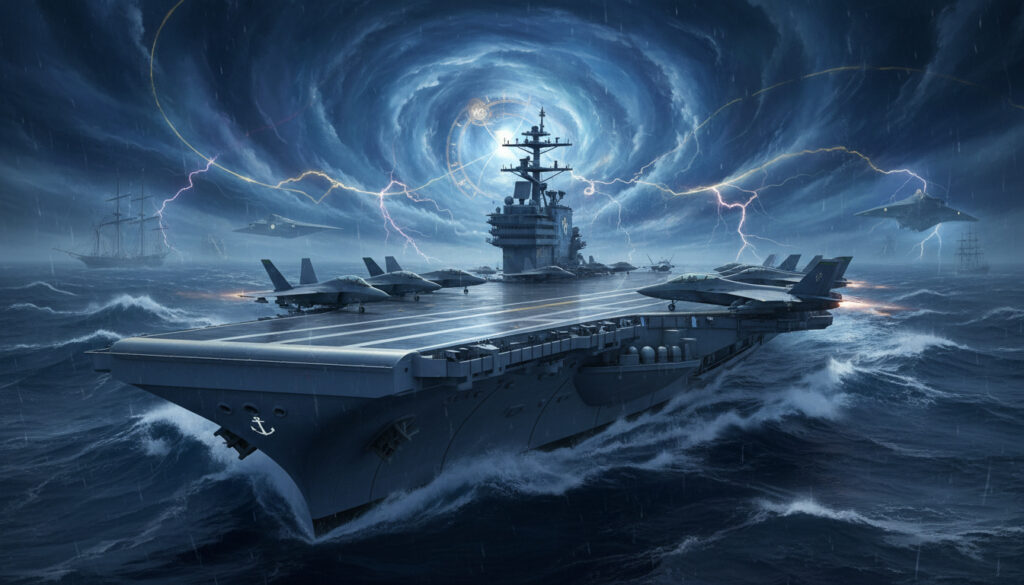
The 1980 science fiction thriller The Final Countdown poses one of military cinema’s most tantalizing hypotheticals: what if a nuclear-powered aircraft carrier from 1980 appeared in the Pacific Ocean on December 6, 1941? Directed by Don Taylor and bolstered by unprecedented access to United States Navy hardware, the film combines time-travel paradoxes with authentic naval operations, creating a unique entry in the military science fiction genre.
The story follows the USS Nimitz, a modern supercarrier commanded by Captain Matthew Yelland, played by Kirk Douglas in one of his later career turns. When a bizarre electrical storm envelops the ship during routine maneuvers, the crew finds themselves transported back to the eve of the Pearl Harbor attack. Martin Sheen appears as Warren Lasky, a civilian systems analyst who serves as the audience’s surrogate, while Katharine Ross portrays Laurel Scott, an efficiency expert caught in the temporal displacement.
At a Glance
| Category | Details |
|---|---|
| Release Date | August 1, 1980 |
| Director | Don Taylor |
| Starring | Kirk Douglas, Martin Sheen, Katharine Ross, James Farentino |
| Runtime | 103 minutes |
| Budget | $12 million |
| Box Office | $16.6 million (domestic) |
Naval Authenticity and the Time Travel Premise
What distinguishes The Final Countdown from contemporaneous science fiction fare is its documentary-level attention to military procedure. The production secured permission to film aboard the actual USS Nimitz, capturing flight deck operations, F-14 Tomcat launches, and the intricate choreography of carrier command with striking realism. This cooperation lent the film a verisimilitude that CGI-heavy productions often lack, grounding the fantastic premise in tactile, mechanical detail.
The temporal mechanics rely on a mysterious electrical storm that acts as a wormhole, a narrative device that allows the screenplay to sidestep complex physics while maintaining dramatic tension. When the crew realizes they possess the firepower to intercept the Japanese attack fleet, the film shifts from spectacle to ethical quandary. Captain Yelland faces the decision of whether to intervene in history, potentially altering the course of World War II, or maintaining neutrality and allowing the catastrophe to unfold as recorded.
Cast and Key Personnel
| Actor | Role | Function Aboard Ship |
|---|---|---|
| Kirk Douglas | Captain Matthew Yelland | Commanding Officer |
| Martin Sheen | Warren Lasky | Systems Analyst |
| Katharine Ross | Laurel Scott | Efficiency Expert |
| James Farentino | Wing Commander Richard Owens | Air Wing Commander |
| Ron O’Neal | Commander Dan Thurman | Executive Officer |
| Charles Durning | Senator Samuel Chapman | 1941 Civilian (Historical Figure) |
Production Realities
The Aspen Film Society produced the picture with a modest $12 million budget, a figure that would have been insufficient without military cooperation. The Department of Defense provided the USS Nimitz, crew members as extras, and technical advisors who ensured that radio protocols, flight procedures, and chain-of-command structures appeared accurate. According to production records, filming occurred during actual naval exercises, with the crew capturing footage that would be impossible to stage on a soundstage.
Director Don Taylor, primarily known for television work including Night Gallery and The Love Boat, approached the material with a straightforward, unadorned style that emphasized the machinery and personnel over stylized cinematography. The decision to shoot in 2.35:1 anamorphic widescreen maximized the visual impact of the carrier deck, allowing the aircraft and ocean expanses to dwarf the human characters and emphasize the isolation of the time-displaced vessel.
Chronology of the Temporal Event
- December 6, 1980 (Present): The USS Nimitz departs Pearl Harbor for routine operations in the Pacific with civilian observers aboard.
- The Vortex: A mysterious, electrically charged storm engulfs the carrier, causing instruments to malfunction and communications to fail.
- December 6, 1941 (Past): The ship emerges from the storm into calm seas. Radio broadcasts and reconnaissance confirm the date—the day before the Japanese attack on Pearl Harbor.
- Morning December 7, 1941: Japanese Zeros encounter Nimitz F-14 Tomcats. The anachronistic confrontation forces Captain Yelland to decide whether to engage the historical enemy fleet.
- The Return: The storm reappears, pulling the ship back to 1980 before the crew can fully intervene, creating a closed time loop.
Clarifying the Causality
The film’s final act generates significant debate regarding bootstrap paradoxes and predestination. When the Nimitz returns to 1980, the crew discovers that their actions in 1941 did occur in historical records, suggesting they participated in a fixed timeline rather than branching history. Senator Chapman, rescued from a 1941 yacht and brought aboard the carrier, ultimately returns to the past through narrative necessity, ensuring that history remains unchanged despite the crew’s advanced knowledge.
This resolution sidesteps the grandfather paradox by suggesting that the time travelers were always part of the historical record. The storm serves as a custodial mechanism of spacetime, preventing major alterations while allowing minor, historically inconsequential interactions. Film historians note that this approach differs from the mutable timelines common in contemporary time-travel narratives like Back to the Future.
Cultural Impact and Reception
Upon release, The Final Countdown garnered mixed critical reception but strong audience engagement, particularly among military enthusiasts. Review aggregators reveal a split between critics who found the premise preposterous and viewers who appreciated the technical accuracy. The film earned approximately $16.6 million domestically against its $12 million budget, ensuring profitability if not blockbuster status.
In subsequent decades, the film developed a substantial cult following, particularly within naval aviation communities. Its standing among 1980s science fiction films rests largely on the practical effects—real jets, real carrier, real ocean—at a time when the genre increasingly embraced digital fantasy. The movie also sparked ongoing discussions about the ethics of intervention in historical tragedies, with military forums debating whether a modern carrier group could actually prevent Pearl Harbor given the logistical and diplomatic constraints.
The production’s influence extends to documentary filmmaking; the footage captured aboard the Nimitz remains among the most cinematic documentation of 1980s naval aviation, with archival value that transcends the narrative film for which it was shot.
Defining Moments
“Now hear this. The USS Nimitz has returned. All hands, secure from general quarters. Set the regular watch.”
— Captain Yelland’s announcement upon returning to 1980
“If we can change history, then we have a moral obligation to do so.”
— Warren Lasky arguing for intervention
“We’re not going to start World War III for anyone.”
— Captain Yelland maintaining discipline
Legacy and Significance
The Final Countdown endures as a time capsule of late Cold War military confidence and cinematic practicality. Unlike the speculative futures of Star Wars or Alien, the film grounds its fantasy in the mechanical reality of American naval supremacy, offering a document of the Nimitz-class carrier that remains historically valuable. Naval historians occasionally reference the footage for its accurate depiction of 1980s deck operations.
The movie’s central question—whether superior technology grants the right to alter history—remains unresolved by design, leaving audiences to wrestle with the ethics of power and the weight of historical trauma. For viewers interested in military hardware, temporal paradoxes, or the specific texture of early-1980s filmmaking, the picture delivers a unique synthesis of documentary realism and speculative fiction.
Frequently Asked Questions
Was the USS Nimitz a real ship?
Yes. The USS Nimitz (CVN-68) is the lead ship of the Nimitz-class aircraft carriers and remains active in the United States Navy. At the time of filming in 1979, the carrier had been commissioned only four years earlier. The Navy provided extensive cooperation for the production, allowing filming during actual operations.
Could the Nimitz have actually stopped the Pearl Harbor attack?
Military analysts suggest that while the modern carrier’s aircraft and missiles could destroy the 1941 Japanese fleet, doing so would raise complex questions about fuel, ammunition depletion, and the ship’s inability to resupply 1940s ordnance. Additionally, warning Pearl Harbor in advance might not have prevented all casualties given the base’s state of readiness in 1941.
What happens at the end of the movie?
The storm returns the Nimitz to 1980 moments before the crew can decisively intervene in the battle. The timeline remains intact, though a final scene reveals that a photograph from 1941 shows the time-displaced characters were always part of history, suggesting a closed causal loop rather than an altered timeline.
Are the F-14 Tomcat scenes real?
Yes. All flight operations use actual F-14 Tomcats, EA-6B Prowlers, and other aircraft from Carrier Air Wing Eight. The production captured catapult launches, arrested landings, and formation flying without miniatures or computer effects, creating aviation footage of exceptional clarity.
Did Kirk Douglas do his own stunts?
Douglas, then 64 years old, performed many of his own scenes on the flight deck, including exposure to jet blast and deck operations. His portrayal of Captain Yelland reflects the authority and physical presence that defined his earlier military roles in films like Paths of Glory.
Is Senator Chapman based on a real historical figure?
The character is fictional, though his presence in the Pacific on December 7, 1941, creates a plausible historical scenario. The film uses his character to explore civilian reaction to modern technology and to create personal stakes for the time-travel narrative.
More related posts
 Apex Legends FAQ: Is It Free? Age Rating & Beginner Tips
 Bengal Cat Guide: Cost, Temperament & Downsides in Ireland
 Dr Keith Suter: Obituary, Cause of Death, Career
 Zachery Ty Bryan: Home Improvement to Prison – What Happened
 Dude Perfect: Verified Facts, Members, and Latest Updates
 Peter Hermann: Career, Family, and Latest Updates 2025
 Tralalero Tralala Meaning – Italian Folk Roots to TikTok Fame
 Tropical Cyclone Alfred Queensland: Impact and Aftermath