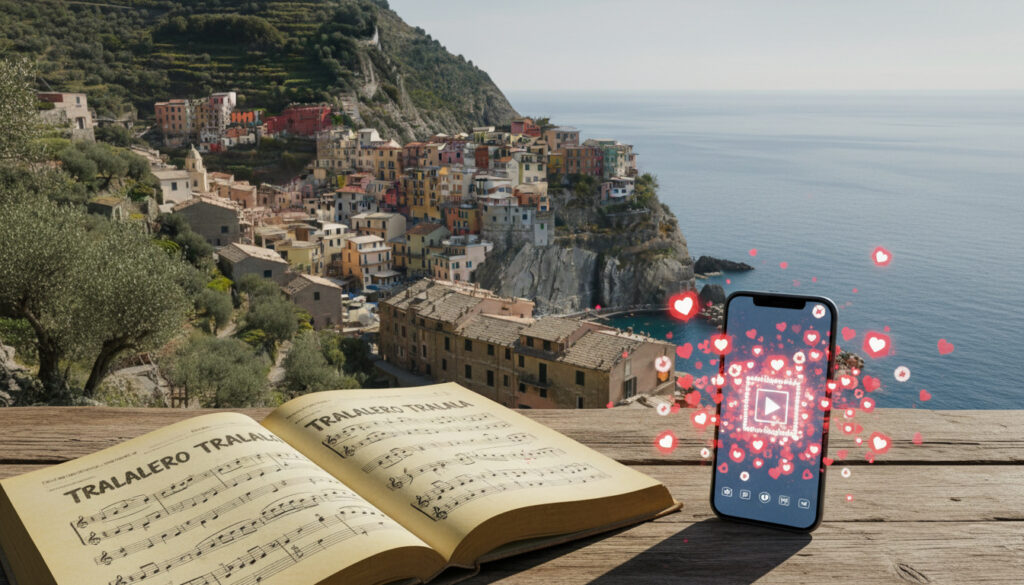
Tralalero Tralala Meaning – Italian Folk Roots to TikTok Fame
The phrase “tralalero tralala” has emerged as a viral soundbite across social media platforms, yet its phonetic roots extend deep into the maritime history of Genoa, Italy. What appears to be simple nonsense syllables actually connects to trallalero, a sophisticated form of polyphonic singing performed by male ensembles in the Ligurian port city since the early 19th century.
While contemporary internet users adopt the expression for carefree, humorous content, the original vocal tradition evolved from rural peasant songs into an urban working-class art form. The transformation reflects broader patterns of cultural migration, from the inland valleys of the Scrivia and Trebbia rivers to Genoa’s dockyards, and eventually to global digital platforms.
What Does Tralalero Tralala Mean?
The syllables carry no literal dictionary definition. Instead, they function as playful, musical nonsense phrases similar to scat singing or rhythmic fillers found across European folk traditions.
- Trallalero refers to a specific Genoese polyphonic singing style
- Tralala functions as onomatopoeic filler without semantic content
- The syllables parallel pragmatic Italian expressions like “mah” or “boh”
- Historical usage emphasizes rhythm and emotional brightness
- Modern viral usage separates the sound from its traditional context
| Fact | Details |
|---|---|
| Literal Meaning | None; vocalization |
| Origin | Genoa, Italy |
| Genre | Folk a cappella |
| Viral Platform | TikTok |
| Syllable Function | Rhythmic filler |
| Traditional Context | Trallalero ensembles |
According to linguistic analysis, these phrases predate modern dictionaries and serve as pragmatic expressions rather than vocabulary words, functioning similarly to Italian interjections that convey attitude rather than concrete meaning. Source
Where Does Tralalero Tralala Come From?
The roots trace back to the early 19th century, evolving from rural singing traditions found in the Ligurian hinterlands, particularly in the valleys of the Scrivia and Trebbia rivers. Peasant communities maintained strong oral traditions of group singing connected to agricultural festivals and religious celebrations.
The Trallalero Singing Style
A typical ensemble, known as a squadra, includes between five and ten singers, each covering a specific vocal part to achieve a layered, almost orchestral sound without instruments. The performance structure includes a Primo (tenor) carrying the main melody, a Contralto adding higher harmonic lines, and a Baritone providing counterpoint. Source
Geographic and Social Origins
Economic changes during the 19th century drove rural workers into Genoa seeking employment in shipyards and port facilities. These vocal traditions migrated to an urban setting, evolving significantly through exposure to opera and cosmopolitan influences arriving through the city’s busy port.
While trallalero is now associated with Genoa, the style originally developed in the rural valleys of the Scrivia and Trebbia rivers before migrating to the city with agricultural workers.
Unlike rural singing styles emphasizing rawness and collective power, trallalero developed highly developed harmonies and stylized improvisations, creating a polyphonic structure with operatic ambition. Source
Why Is Tralalero Tralala Viral on TikTok?
The tradition gained new life in the digital age when Italian videos featuring grandmother figures and the characteristic syllables began circulating on TikTok in the early 2020s. By 2024, the sound had evolved into a global meme, used to convey carefree vibes and humorous scenarios.
The Social Media Phenomenon
Viral clips typically feature the “tra-la-la” sounds divorced from their complex harmonic context, reducing the sophisticated polyphony to a simple, catchy phrase. This represents a common pattern wherein traditional cultural elements undergo simplification for rapid digital consumption.
Italian videos featuring the syllables gained traction on TikTok, transforming a regional vocal tradition into a global meme sound by 2024.
Modern Adaptation
The tradition has been adapted to include female singers—a historical innovation—though it maintains its core identity. Contemporary accounts suggest the viral trend has sparked renewed interest in the original Genoese tradition, though the exact source videos for specific viral clips remain difficult to verify.
Tralalero Tralala Lyrics and Cultural Context
Trallalero is fundamentally tied to the Genoese dialect, with songs dedicated to the lived experiences of working-class communities. Common themes include love, labor, nostalgia, and maritime life.
Performance Structure
Performers usually stand in a semicircle facing one another to facilitate communication through subtle visual cues. Songs often begin with a solo voice before other parts join in, layering harmony upon harmony. The name itself derives from the syllabic “tra-la-le-ro,” a playful, rhythmic filler commonly used in the songs.
Themes and Geographic Shift
One of the most emblematic songs is La Partenza, which narrates the sorrowful departure of sailors and emigrants leaving their homeland. According to contemporary accounts, Genoa’s urban gentrification has pushed trallalero outside the city into the mountains behind Genoa, with the tradition now more alive in small villages than in the city itself. Source
Due to urban gentrification in Genoa, trallalero ensembles have relocated to mountain villages, creating an unusual reversal where this urban art form now survives primarily in rural settings.
This represents an unusual reversal: a folk music quintessentially urban in nature is now moving to a more rural setting, contrasting with many other folk traditions that began rural but became widely practiced in cities.
How Did Tralalero Tralala Spread Over Time?
- : Trallalero emerges in Genoa dockyards as rural workers migrate to the city
- : Folk groups record the tradition; decline begins mid-century due to industrial changes and wars
- : Ethnomusicologist Alan Lomax records trallalero performances during fieldwork in Italy
- : Italian videos featuring the syllables go viral on TikTok
- : Global meme sound emerges, detached from traditional context
Ethnomusicologists like Alan Lomax and Italian scholars such as Mauro Balma played crucial roles in preserving and reviving interest in this vocal tradition during the 20th century. While the exact meaning of the syllables remains elusive, you can explore the Nilavuku En Mel Ennadi Kobam meaning for further insights.
What Do We Know for Certain About Tralalero Tralala?
| Established Information | Information That Remains Unclear |
|---|---|
| Trallalero is an established Genoese tradition dating to the early 19th century | The exact source song for specific viral TikTok clips varies by video |
| Tralala functions as scat singing syllables without literal meaning | No standard “tralalero tralala” lyrics exist in the viral context |
| The tradition evolved from rural to urban settings | The precise trajectory of the viral spread remains partially documented |
| Urban gentrification has pushed the tradition to mountain villages | Long-term survival prospects in the digital age are uncertain |
How Does Tralalero Tralala Fit Into Broader Culture?
Historically, “tra-la-la” sounds appear throughout European folk songs, children’s rhymes, and opera choruses, serving rhythmic and emotional functions. The Genoese variant stands out for its complex polyphonic arrangement and working-class origins, distinct from simpler folk styles.
The modern digital adaptation illustrates how traditional vocalizations can transcend linguistic barriers, becoming what some researchers call What is vertigo? in cultural transmission—disorienting yet compelling shifts in context that challenge traditional preservation methods.
Today, trallalero remains a living, if endangered, tradition, with enthusiast groups continuing to perform and teach the style, often participating in festivals dedicated to safeguarding folk music heritage such as the Le Vie dei Canti festival.
What Do Cultural Experts Say About Trallalero?
Trallalero is a highly distinctive form of polyphonic singing that originated in Genoa, Italy, characterized by complex harmonies and unique vocal techniques traditionally performed by male ensembles.
— Cultural Documentation, UNESCO Intangible Cultural Heritage notes
Scholars emphasize that the tradition became especially popular among dockworkers, artisans, factory workers, and sailors, many of whom formed amateur singing groups as part of their social life. At its height in the late 19th and early 20th centuries, trallalero represented an important part of Genoese popular culture.
The psychological dimensions of cultural preservation sometimes mirror questions asked in What is a narcissist?—specifically, how communities balance self-interest with collective heritage maintenance in the face of modernization.
What Is the Core Meaning of Tralalero Tralala?
Ultimately, “tralalero tralala” represents a bridge between the sophisticated polyphonic traditions of 19th-century Genoese dockworkers and the ephemeral, decontextualized sounds of contemporary social media. While the syllables themselves convey no dictionary definition, they carry the weight of cultural migration—from rural Ligurian valleys to urban ports, and now to digital platforms—embodying the resilience of folk traditions even as they transform beyond recognition.
Frequently Asked Questions
Is tralalero tralala a real Italian song?
It refers to the trallalero tradition, but the viral “tralalero tralala” is typically a soundbite rather than a specific named song with standard lyrics.
What is the difference between trallalero and tralala?
Trallalero is the specific Genoese polyphonic singing style; tralala refers to the nonsense syllables used within it and in broader folk contexts.
Why did trallalero move to the mountains?
Urban gentrification in Genoa has pushed the tradition to rural mountain villages behind the city, reversing its historical urban concentration.
Who recorded trallalero performances historically?
Ethnomusicologist Alan Lomax recorded performances during fieldwork in Italy in the 1950s, preserving the tradition during its mid-century decline.
Can women perform trallalero?
Though traditionally performed by male ensembles, the tradition has been adapted in recent years to include female singers.
What does “La Partenza” mean?
It means “The Departure” and is one of the most emblematic trallalero songs, narrating the sorrowful leave-taking of sailors and emigrants.
Are there lyrics to tralalero tralala?
The viral sound typically uses nonsense syllables without fixed lyrics, though traditional trallalero songs feature complex lyrics in the Genoese dialect.
More related posts
 Commonwealth Bank Swift Code – Same for All Branches
 Sammy Virji: Real Name, Age, Net Worth & Parents Guide
 Barbara O’Neill: Diet, Supplements, Weight Loss & Life
 Hudson Williams: Age, Ethnicity, Girlfriend, and Heated Rivalry
 Tom Morris: Journalist, Golfer, Philosopher – Who Is He
 Mazzy Star: What Really Happened to the Band & Hope Sandoval
 Figure 8 Pools Guide: Walk Distance, Safety & Best Time to Visit
 Ange Postecoglou: Al-Nassr Appointment, Salary & Career