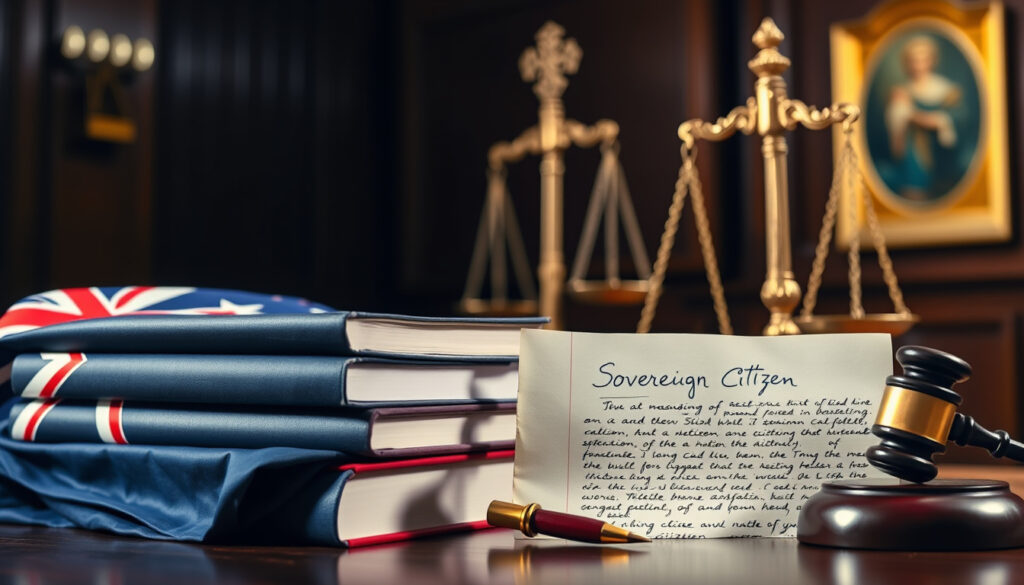
Sovereign Citizen Australia: Meaning, Citizenship and Laws
Mention the term “sovereign citizen” in Australia, and most people picture someone refusing to pay a speeding fine or filing bizarre legal paperwork. But the movement has quietly evolved from isolated tax refusers into a more organized, ideologically driven network that police and courts now take seriously.
Historical residency requirement for citizenship: 10 years ·
Current residency requirement for citizenship: 4 years ·
First sovereign citizen case in Australia: 1980s ·
Sovereign citizen growth since 2020: Significant (per judicial reports)
Quick snapshot
- Sovereign citizens reject government authority (Sunrise (Seven Network))
- Australian courts consistently reject sovereign citizen arguments (NSW Judicial Commission)
- Australia can revoke citizenship under the Citizenship Act 2007 (Australian Government Federal Register of Legislation)
- Exact number of sovereign citizen adherents in Australia (Taylor & Francis Journal (academic research))
- Future growth trajectory of the movement (Australian Federal Police Report)
- Precise number of citizenship revocations (Department of Home Affairs)
- Movement emerges in US in 1970s (Wikipedia)
- First cases in Australia in 1980s (Australian Federal Police Report)
- Significant growth after 2020 (NSW Judicial Commission)
- ASIO and AFP increasing scrutiny of the movement (Wikipedia)
- Police revoking gun licences of known members (Sunrise (Seven Network))
- Ongoing risk of lone-actor violence from ideologically motivated individuals (Lowy Institute (think tank))
Four key facts set the stage for understanding how the movement clashes with Australia’s citizenship and legal framework.
| Fact | Detail |
|---|---|
| Sovereign citizen movement origin | United States, 1970s (Wikipedia) |
| Australian citizenship act | Citizenship Act 2007 (Australian Government Federal Register of Legislation) |
| Head of State | King Charles III (The Royal Family (official website)) |
| Standard residency for citizenship | 4 years (1 year as permanent resident) (Australian Department of Home Affairs) |
What does it mean to be a sovereign citizen of Australia?
Beliefs and ideology
- Sovereign citizens reject the authority of courts, police, and all levels of government, arguing they are not subject to Australian law unless they have explicitly consented (Sunrise (Seven Network)).
- Many Australian sovereign citizens call themselves “freemen on the land” and engage in pseudolaw — filing nonsensical legal documents that argue they are separate from the state (Taylor & Francis Journal (academic research)).
- They often create fake driver’s licenses, vehicle registration tags, and liens against government officials as acts of “redemption” (UNC School of Government Guide (judicial guidance)).
Sovereign citizens treat Australian law as a “contract” they never signed. But the High Court of Australia has ruled that government authority does not require individual consent — it derives from the constitution and the democratic system itself.
Legal implications in Australia
- Australian courts have consistently rejected sovereign citizen arguments as “futile,” “vexatious,” and without legal merit (NSW Judicial Commission (official judicial guidance)).
- The NSW Judicial Commission notes that sovereign citizen activities waste court resources and harm the litigants themselves, who often end up with costs orders or contempt findings (NSW Judicial Commission (official judicial guidance)).
- Judges are now trained to identify sovereign citizen tactics and deal with them quickly — a practice standardized through bench books (NSW Judicial Commission (official judicial guidance)).
Historical roots in the United States
- The sovereign citizen movement originated in the United States during the 1970s, emerging from white supremacist and anti-tax groups (Wikipedia).
- It spread to other common law countries including Australia, Canada, and the United Kingdom (Taylor & Francis Journal (academic research)).
- The Australian iteration began with isolated tax refusers in the 1980s, according to an Australian Federal Police report, but has since evolved into a more networked movement (Australian Federal Police Report (tier 1 law enforcement analysis)).
Can you be denaturalized in Australia?
Grounds for citizenship revocation
- Australia can revoke citizenship under the Australian Citizenship Act 2007 (Australian Government Federal Register of Legislation).
- Revocation grounds include fraud or misrepresentation in the application, conviction of certain serious crimes, and, for dual citizens, engagement in terrorism-related conduct or foreign fighting (Department of Home Affairs).
- The government cannot make a person stateless — any revocation requires the person to hold citizenship of another country (Department of Home Affairs).
Role of the Department of Home Affairs
- The Department of Home Affairs is the body responsible for citizenship decisions, including revocations (Department of Home Affairs).
- The Minister for Home Affairs has the power to revoke citizenship by order in certain situations (Australian Government Federal Register of Legislation).
Number of revocations and notable cases
- Citizenship revocation is relatively rare in Australia. While specific, up-to-date aggregate numbers are not public, the government has used the power primarily against dual citizens convicted of terrorism offenses or who have fought with foreign militant groups (Department of Home Affairs).
- Notable cases include individuals who hold, for example, UK, Turkish, or Lebanese citizenship alongside Australian — their Australian citizenship was cancelled after terrorism-related convictions (ABC News (established editorial publication)).
- For sovereign citizens who are Australian-born and hold no other passport, the government cannot revoke their citizenship — which is why the debate remains largely symbolic for them (Lowy Institute (think tank)).
Sovereign citizens who are dual nationals — particularly those who also hold UK, US, or European passports — could theoretically face revocation if they commit specific terrorism-linked crimes. But the Department of Home Affairs has not to date pursued mass revocation as a strategy for the movement.
What is the 10 year rule in Australia?
Historical context
- Before 2007, the Australian Citizenship Act required applicants to have lived in Australia as a permanent resident for a total of 10 years before they could apply for citizenship (Australian Government Federal Register of Legislation).
- This “ten-year rule” was a significant barrier — it meant many long-term temporary residents and migrants had to spend a decade in limbo before gaining the right to vote or hold an Australian passport (Australian Parliament House (official legislative archive)).
Current citizenship requirements
- The Australian Citizenship Act 2007 replaced the ten-year rule with a 4-year residency requirement, including one year as a permanent resident (Australian Government Federal Register of Legislation).
- Applicants still must pass a citizenship test, demonstrate basic English, and show they are likely to reside in Australia or maintain a close connection (Australian Department of Home Affairs).
- The change significantly simplified the pathway, reducing the time needed from ten years to four (Australian Parliament House (official legislative archive)).
The ten-year rule’s replacement
- The rule was phased out for all new applicants from July 2007 (Australian Government Federal Register of Legislation).
- Some systems — like the old “10 year rule” for former Australian residents who had left — no longer apply. Today, the standard residency requirement is consistent and simplified (Australian Department of Home Affairs).
- Sovereign citizens sometimes cite the older, more restrictive rule as evidence that Australian citizenship is “conditional” or “granted under contract” — a misreading of its original intent as a residency rule rather than a legal bar (Sunrise (Seven Network)).
Is Australia still a sovereign country?
Australia’s constitutional monarchy
- Australia is a sovereign nation with its own constitution, adopted by referendum in 1901 (Australian Parliament House (official constitutional text)).
- The British monarch — currently King Charles III — is Australia’s head of state, represented by the Governor-General at the federal level and by governors in each state (The Royal Family (official website)).
- The monarch’s role is largely ceremonial; executive power is exercised by the Prime Minister and Cabinet, who are accountable to the Australian Parliament (Australian Government Department of Prime Minister and Cabinet).
Legal independence from the UK
- Australia has full legislative independence from the United Kingdom since the Australia Act 1986 (Australian Government Federal Register of Legislation).
- The High Court of Australia is the final court of appeal for all Australian matters — no appeal can be made to the UK Privy Council (High Court of Australia (official website)).
- Sovereign citizens often argue that Australia is still a “colony” or that its laws are invalid because the monarch is British — a claim that the High Court has repeatedly dismissed (Lowy Institute (think tank)).
Debates on becoming a republic
-
Australia has had a long-running debate about replacing the constitutional monarchy with an Australian republic, but a 1999 referendum on the issue was defeated (Australian Electoral Commission (official electoral body)).
-
Opinion polls fluctuate on public support for a republic, but no proposal has yet gained enough parliamentary and popular support to pass (Lowy Institute (think tank)).
-
Even if Australia became a republic, it would not change the legal status of citizenship or the validity of laws — that is a separate question from sovereignty (Australian Parliament House (official constitutional text)).
How difficult is it to get an Australian citizenship?
Eligibility and pathways
- Applicants must be permanent residents for at least 1 year (and have lived in Australia for at least 3 of the last 5 years) (Australian Department of Home Affairs).
- They must pass a citizenship test covering Australian values, history, and legal system, with a pass mark of 75% (Australian Department of Home Affairs).
- Applicants must also demonstrate good character, willingness to reside in Australia, and a basic knowledge of English (Australian Department of Home Affairs).
The implication: the pathway is straightforward on paper, but the process requires careful documentation and legal compliance — exactly the kind of government authority that sovereign citizens reject.
Related reading: Australian Federal Election Results – 2022 Seats, Votes and Analysis
Understanding how citizenship laws apply in practice can be seen in cases like Elon Musks US citizenship, which illustrates the naturalization process for high-profile individuals.
Frequently Asked Questions
How to become a sovereign citizen in Australia?
There is no formal process to become a sovereign citizen. Individuals typically adopt the ideology by watching online videos, joining social media groups, and filing pseudolegal documents. The AFP and NSW Judicial Commission warn that this path leads to legal penalties, not immunity.
How many sovereign citizens are there in Australia?
No exact count exists. A 2015 NSW assessment estimated up to 300 adherents in that state, but the movement has grown significantly since 2020, according to the NSW Judicial Commission. The AFP reports the movement is increasingly organized but lacks a single centralized membership list.
How to deal with sovereign citizens in legal contexts?
Australian judges are trained to identify sovereign citizen tactics and handle them quickly per the NSW Judicial Commission bench books. For individuals facing harassment, legal advice and reporting to police are recommended. The AFP has increased scrutiny of the movement after the 2022 Wieambilla shootings.
Can you lose Australian citizenship if you become a sovereign citizen?
No. Simply identifying as a sovereign citizen does not trigger citizenship revocation. Revocation requires fraud in the application, terrorism convictions, or foreign fighting — criteria the government applies regardless of ideological beliefs, as per the Department of Home Affairs.
What are the beliefs of sovereign citizens in Australia?
They reject the authority of courts, police, and government, claiming laws apply only with individual consent. Many adopt “freemen on the land” terminology and file pseudolegal documents, as documented by academic research in Taylor & Francis journals.
Is the sovereign citizen movement illegal in Australia?
The ideology itself is not illegal, but actions taken under it — such as filing fraudulent documents, refusing to comply with court orders, or threatening officials — can lead to criminal charges. The AFP has warned about the movement’s overlap with extremism but has not called for a blanket ban.
More related posts
 Shah Rukh Khan – Age, Wife, Movies, Awards and Facts
 2025 Melbourne Cup Field justhorseracing.com.au – Full Results and Analysis
 The Silent Patient: Plot, Twist, Movie Adaptation & More
 Catherine McClements: Biography and Current Projects
 Janet Sheen: Biography, Marriage, and Children
 ANA Airlines Review: Skytrax 5-Star, Economy, and Ownership
 Sabrina Carpenter: Biography, Age, Height, Songs, Movies
 Jessica Pegula: Net Worth, Husband, Ranking, Career Highlights