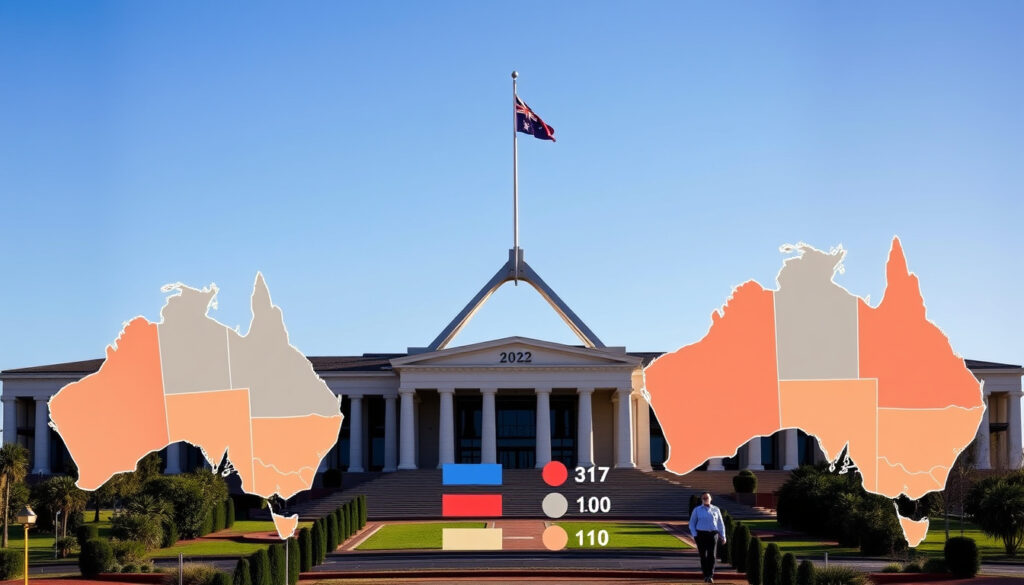
Australian Federal Election Results – 2022 Seats, Votes and Analysis
Australia went to the polls on 21 May 2022 in a federal election that marked a significant political shift. The Australian Labor Party, led by Anthony Albanese, secured a majority in the House of Representatives, ending nine years of Liberal-National Coalition rule. The election saw record-low support for the major parties, with independents and minor parties capturing more than 30 percent of the primary vote for the first time in modern history.
The result delivered Labor 77 seats in the 151-member lower house, providing the party with an outright majority government. The Coalition, led by incumbent Prime Minister Scott Morrison, suffered substantial losses, particularly in suburban Liberal heartlands and Western Australia. Scott Morrison conceded defeat on election night, with Peter Dutton subsequently becoming Liberal leader.
Voter turnout dropped to 89.82 percent, the lowest since before compulsory voting was introduced in Australia in 1922. The Greens party also made historic gains, winning multiple seats in Brisbane and securing enough Senate seats to hold the balance of power alongside other crossbench members.
Who Won the 2022 Australian Federal Election?
The Australian Labor Party won the 2022 federal election, forming a majority government under the leadership of Anthony Albanese. The election was held on Saturday, 21 May 2022, with counting continuing for several days before Labor’s victory was formally declared.
Labor Party (77 seats)
Coalition (58 seats)
21 May 2022
Anthony Albanese
Key Takeaways from Election Night
- Anthony Albanese became Australia’s 31st Prime Minister, ending Coalition rule that began in 2013
- Labor secured majorities in all states except Tasmania
- The combined two-party preferred vote for major parties fell to record lows
- Teal independent candidates won seven previously safe Liberal seats
- Western Australia delivered the largest swing to Labor, with a 10.6 percent shift in two-party preferred vote
- The Greens won three inner-city Brisbane seats, their first multi-seat lower house wins
- Voter turnout reached its lowest point since 1922
2022 Federal Election Results at a Glance
| Party | House Seats | Senate Seats | Primary Vote % | Two-Party Preferred % |
|---|---|---|---|---|
| Labor | 77 | 26 | 32.58% | 50.99% |
| Coalition | 58 | 32 | 35.69% | 38.41% |
| Greens | 4 | 12 | 12.25% | 2.65% |
| Independents/Teals | 10 | 1 | 5.29% | 6.62% |
| Other Parties | 2 | 5 | 4-5% each | <1% |
House of Representatives Seat Results by Party
The 2022 federal election produced a decisive result in the House of Representatives, with Labor winning 77 of the 151 seats. This gave the party an outright majority, eliminating the need for coalition arrangements or confidence-and-supply agreements with crossbench members.
Labor’s Path to Government
Labor secured its majority primarily through gains in Western Australia, where the party won a majority of seats for the first time since 1990. The 10.6 percent swing in Western Australia’s two-party preferred vote represented the largest state-level shift toward Labor in the election. NSW provided additional seat gains, particularly in suburban electorates that had traditionally supported the Coalition.
The party also benefited from preferences flowing from Greens candidates in inner-city seats, helping Labor claim victory in several tight contests. By the end of counting, Labor had secured majorities in every state except Tasmania, where the Coalition retained a narrow advantage.
Coalition’s Electoral Performance
The Liberal-National Coalition finished with 58 seats, representing a significant decline from its previous position. The Liberal Party won 27 seats, the Nationals took 10, and the Liberal National Party (LNP) in Queensland secured 21. This breakdown reflects the Coalition’s composite nature across different states and territories.
Scott Morrison conceded defeat on election night and subsequently resigned as Liberal Party leader. Peter Dutton was elected as his successor, becoming the new Leader of the Opposition. The defeat marked the end of the Coalition’s nine-year period in government since winning power under Tony Abbott in 2013.
Key Marginal Seats and Swings
The 2022 election saw dramatic shifts in several marginal seats across the country. Western Australia delivered the most pronounced change, with the Australian Electoral Commission reporting swings of up to 15 percent in some seats toward Labor candidates. Several coastal seats that had been held by the Liberal Party for decades fell to Labor, contributing significantly to the overall result.
The combined primary vote for Labor and the Coalition fell to 68.3 percent, the lowest recorded figure in Australian federal politics. Minor parties and independent candidates captured a record 31.7 percent of first-preference votes, reflecting growing voter dissatisfaction with the major parties.
The Rise of Teal Independents
Perhaps the most striking feature of the 2022 election was the success of teal independent candidates in previously safe Liberal seats. These candidates, primarily running in affluent metropolitan electorates, campaigned on platforms emphasizing climate action, government integrity, and gender equality. Their success represented a significant realignment in Australian electoral politics.
The teal independents collectively won seven additional seats beyond the three they had held previously, bringing their total representation to 10 in the new Parliament. Most of these gains came at the expense of long-serving Liberal members who had held their seats for extended periods. Candidates like Kylea Tink, Zaky Mallah, and others successfully appealed to voters frustrated with the major parties’ handling of issues including climate change and parliamentary standards.
Greens’ Historic Brisbane Breakthrough
The Australian Greens achieved their best-ever result in a federal lower house election by winning three seats in inner-city Brisbane. This marked the first time the Greens have held multiple lower house seats in a single state, representing a substantial breakthrough in their electoral strategy. The gains were concentrated in the Brisbane electorate, where the party’s primary vote exceeded 20 percent in several booths.
The Greens’ success in Brisbane built on years of community organizing and was facilitated by Labor preferences flowing to Greens candidates in tightly contested seats. This tactical voting pattern proved particularly effective in inner-urban areas where progressive voters sought to maximize representation for their preferred candidates.
Senate Results and Independents’ Impact
The Senate election produced a more complex outcome, with 40 of the 76 seats contested in this election cycle. The final composition of the Senate reflects significant shifts in voter preferences, with the Greens more than doubling their representation while maintaining their balance of power position.
Senate Seat Allocation
When the final count was complete, the Coalition remained the largest party in the Senate with 32 seats, though this figure includes senators from various states with different term lengths. Labor held 26 seats, with the party’s overall Senate representation unchanged from the previous parliament. The Greens secured 12 seats, gaining three from their previous total and now holding two senators from each state.
Several minor parties and independent senators also achieved representation. One Nation gained a seat in Queensland, bringing their total to two. The Jacqui Lambie Network expanded to two seats, while David Pocock won election as an independent from the Australian Capital Territory. The United Australia Party retained one Senate position.
With the Greens holding 12 seats and other crossbench members comprising an additional six, the government requires negotiation with these senators to pass legislation. The Greens’ balance of power position gives them significant leverage in Senate negotiations.
The Role of Independents in the New Parliament
Independents played an unprecedented role in the 2022 election, with teal candidates reshaping the political landscape in the House of Representatives. Beyond the teal independents, traditional independent MPs like Andrew Gee, Bob Katter, and Rebekha Sharkie retained their seats. The Centre Alliance representative from South Australia held their position, as did Katter’s Australian Party representative from Queensland.
In the Senate, the increased crossbench size means the government must build broader coalitions to pass legislation. This dynamic gives minor parties and independents greater influence over policy outcomes, particularly on issues where the government lacks an outright Senate majority of its own.
Election Date and Vote Percentages
The 2022 Australian federal election took place on Saturday, 21 May 2022. Australia operates under compulsory voting laws, requiring all eligible citizens to cast ballots, though the requirement to mark a valid vote means some ballots remain informal. Polling stations opened at 8am and closed at 6pm local time across all time zones, with the Australian Electoral Commission overseeing the conduct of the election.
Primary Vote Breakdown
First-preference votes, also known as primary votes, provide a measure of direct voter support for each party without the influence of preference distributions. The 2022 results showed the Labor Party receiving 32.58 percent of the primary vote, a slight increase from the previous election but not dramatically different from historical averages.
The Coalition received 35.69 percent of primary votes, its lowest share in recent decades. The Greens improved to 12.25 percent nationally, building on their strong performance in inner-city areas. One Nation captured 4.96 percent, the United Australia Party received 4.12 percent, and independent candidates collectively took 5.29 percent of first-preference votes.
The combined major party vote of 68.3 percent represents a historic low, demonstrating the extent to which Australian voters have moved away from the traditional two-party system. Minor parties and independent candidates now represent nearly one-third of all primary votes cast.
Two-Party Preferred Results
The two-party preferred vote, which distributes preferences until only two candidates remain, provides the definitive measure used to determine seat winners in Australia’s preferential voting system. Labor achieved 50.99 percent nationally, while the Coalition secured 38.41 percent after preferences were distributed.
Regional variations were significant. Western Australia delivered a 10.6 percent swing to Labor, while other states also recorded swings toward the ALP. Tasmania was the only state where the Coalition improved its position. The national swing to Labor, while modest in percentage terms, was enough to flip numerous marginal seats due to the concentration of competitive electorates.
What Remains Verified and What Is Unclear
Verified Information
- Labor won 77 House seats, majority government
- Coalition won 58 House seats
- Anthony Albanese became Prime Minister
- Election held on 21 May 2022
- Voter turnout was 89.82 percent
- Senate composition finalized after full count
Areas Requiring Further Clarity
- Detailed demographic breakdowns by electorate
- Long-term impact of teal independent surge
- Future electoral boundary adjustments
- Policy implementation timeline specifics
Background and Historical Context
The 2022 election concluded a period of significant political turbulence that included three different prime ministers during the Coalition’s nine-year tenure. Malcolm Turnbull, Julie Bishop, Tony Abbott, and others had served in various leadership capacities, contributing to internal party divisions that observers identified as factors affecting the Coalition’s electoral standing.
Australia’s compulsory voting system means that voter turnout traditionally exceeds 90 percent, making the 89.82 percent figure notable. The decline reflects growing community debate about electoral participation, though Australia still maintains among the highest participation rates in democratic nations globally.
The political landscape has shifted considerably since the major parties dominated Australian politics in the post-war period. The 2022 results continue trends visible in recent elections, where minor parties and independent candidates have increasingly attracted voter support. This fragmentation presents both challenges and opportunities for the major parties as they seek to rebuild their electoral coalitions.
Sources and Official Declarations
The Australian Electoral Commission serves as the official source for all federal election results. The commission publishes detailed data on its website, including booth-by-booth results, preference distributions, and formal declarations. The parliamentary library also maintains comprehensive research papers documenting the election outcome.
The 2022 Australian federal election results demonstrated a clear mandate for change, with the Australian Labor Party forming majority government under Anthony Albanese after nine years of Liberal-National Coalition rule.
International parliamentary bodies, including the Inter-Parliamentary Union, have published data confirming the official Australian election results. These independent verifications provide additional validation of the outcome reported by the AEC.
Looking Ahead: The Next Federal Election
Under Australian constitutional requirements, the next federal election must occur by May 2025 at the latest. This election will see all 151 House of Representatives seats contested, along with 40 of the 76 Senate seats. The fixed terms legislation means that elections can be called earlier than the deadline, and some observers have noted that early elections remain possible under certain circumstances.
The Albanese government will spend its first term implementing its policy platform while preparing for the next electoral contest. Key issues likely to shape the next campaign include economic management, climate policy, housing affordability, and the integrity of political institutions. The success or failure of the government’s response to these challenges will likely determine the electoral outcome in 2025.
For those following the economic context of Australian politics, it is worth noting that CommBank share price movements and broader economic indicators often feature prominently in electoral discussions. Additionally, state-level initiatives such as Fuel Watch WA demonstrate the range of policy mechanisms governments employ between federal election cycles.
Frequently Asked Questions
When is the next Australian federal election?
The next Australian federal election must be held by May 2025 at the latest. All 151 House of Representatives seats and 40 Senate positions will be contested.
How did the Coalition perform in the 2022 Australian election?
The Coalition won 58 seats in the House of Representatives and 32 Senate seats, representing significant losses from its previous position. Scott Morrison conceded defeat on election night.
How many seats did Labor win in 2022?
Labor won 77 seats in the 151-member House of Representatives, securing an outright majority and eliminating the need for coalition arrangements.
What role did teal independents play in the 2022 election?
Teal independent candidates won seven additional seats, bringing their total representation to 10. Most gains came at the expense of long-held Liberal seats in affluent metropolitan areas.
What was the voter turnout in the 2022 Australian federal election?
Voter turnout was 89.82 percent, the lowest recorded since before compulsory voting was introduced in Australia in 1922.
Who became Prime Minister after the 2022 election?
Anthony Albanese became Australia’s 31st Prime Minister after Labor won the 2022 federal election, ending nine years of Coalition government.
What happened in the Senate in the 2022 election?
The Senate saw the Greens double their representation to 12 seats, giving them balance of power. The Coalition remained the largest party with 32 seats, while Labor held 26.
More related posts
 James Dean: Death, Movies, and the Rebel Icon
 Tracy Cortez: Relationship, Ethnicity, and UFC Career
 Bradley Walsh: Health, Marriages, Family & Career Facts
 Amy Poehler: Relationships, Diagnosis, and Tina Fey Friendship
 Monty Python: Members, Movies, and Controversies
 Kmart Chirnside Park: Address, Hours, Phone & Services
 65 Inch TV – Best Picks Under $1000 Reviewed