Mount Buffalo National Park: A Complete Guide
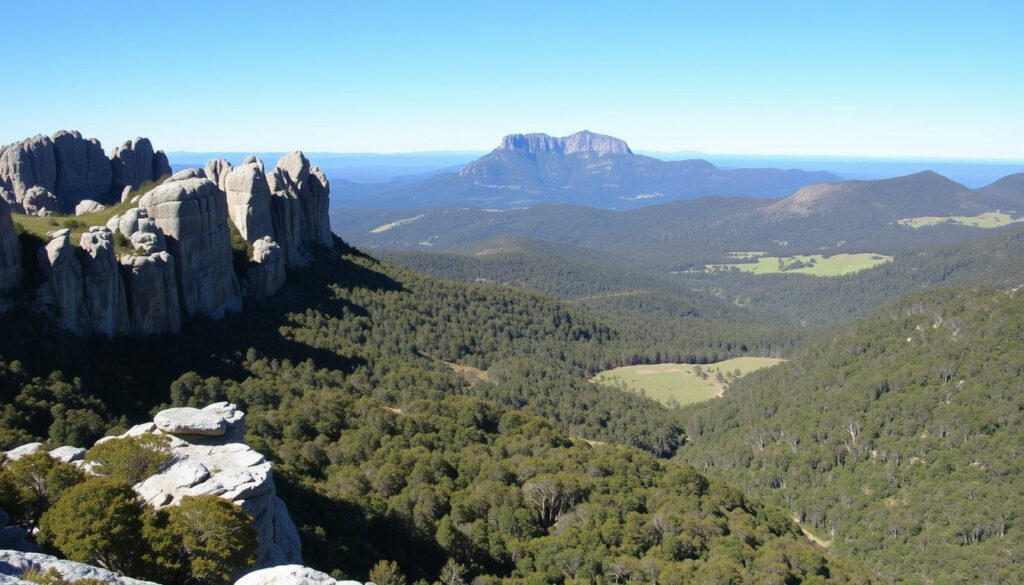
A flat‑topped peak rising above the Ovens Valley, Mount Buffalo is a 31,000‑hectare alpine plateau with free entry year‑round — not a typical pointy mountain. You can hike among ancient granite tors in the morning and build a snowman in the afternoon, all without paying a cent to get in.
Elevation: 1,723 m (5,653 ft) ·
Area: 31,000 hectares ·
Entry fee: Free ·
Established: 1898
Quick snapshot
- Mount Buffalo is a plateau in the Australian Alps, Victoria (Wikipedia (encyclopedic overview))
- Free entry all seasons (Visit Mount Buffalo (official park tourism site))
- Elevation 1,723 m (Wikipedia)
- Contains 550 plant species including endemics (Visit Mount Buffalo)
- Exact depth of snow each winter is weather-dependent
- Road closures due to snowfalls are unpredictable
- Chalet reopening timeline not confirmed
- Named Mount Buffalo in 1824 by explorers Hume and Hovell (Wikipedia)
- Proclaimed a National Park in 1898 (Wikipedia)
- Mount Buffalo Chalet opened 1910, now heritage site (Wikipedia)
- Popular ski destination 1920s-1960s; focus shifted to nature tourism since 2000s (Wikipedia)
- Ongoing conservation and nature tourism development (Parks Victoria (government park management))
- Chalet restoration uncertain (Visit Bright (regional tourism authority))
- Popularity continuing to grow for year-round outdoor activities (We Are Explorers (outdoor adventure publication))
Six key specifications define what Mount Buffalo offers visitors — a combination of geography, access rules, and seasonality that sets it apart from other Victorian parks.
| Specification | Detail |
|---|---|
| Mountain range | Australian Alps |
| Elevation | 1,723 m (5,653 ft) |
| Area | 31,000 hectares |
| Entry fee | Free (all seasons) |
| Established as National Park | 1898 |
| State | Victoria, Australia |
| Nearest town | Bright (40 km away) |
| Management agency | Parks Victoria |
Is Mount Buffalo worth visiting?
Mount Buffalo National Park delivers a rare combination in Victoria: free entry, year‑round access, and a landscape that shifts from sculpted granite tors in summer to snow‑dusted trails in winter. The question isn’t whether to go — it’s when.
What makes Mount Buffalo unique?
- Sheer cliffs, imposing granite tors, tumbling waterfalls — the park’s geology is ancient and dramatic (Visit Mount Buffalo (official park tourism site))
- Home to 550 species of native plants, with some found nowhere else on Earth (Visit Mount Buffalo)
- Charismatic Australian wildlife: eastern grey kangaroos, wallabies, wombats (Visit Bright (regional tourism authority))
What are the top activities at Mount Buffalo?
- Sightseeing: panoramic views from The Horn, Eurobin Falls, Rollasons Falls
- Hiking: over 40 km of trails, from easy strolls to challenging climbs (AllTrails (hiking trail database))
- Camping at Lake Catani (November–April) or snow camping in winter
- Rock climbing on the granite faces (Visit Mount Buffalo)
- Cross‑country skiing and snow play in winter (We Are Explorers (outdoor adventure publication))
Why is Mount Buffalo called Mount Buffalo?
What is the origin of the name Mount Buffalo?
European explorers Hamilton Hume and William Hovell named the mountain in 1824, reportedly because its silhouette from a distance resembled a buffalo’s hump (Wikipedia (encyclopedic overview)). The mountain is actually a flat‑topped plateau, not a single peak — a quirk that makes the name more evocative than literal.
Does Mount Buffalo have a different Aboriginal name?
The traditional name from the Taungurung people, the original custodians of this land, has not been recorded in surviving sources. The Taungurung language group’s knowledge continues to be revived by community efforts, but no pre‑colonial name for the mountain appears in published ethnographies or park materials. Parks Victoria acknowledges the Taungurung as the Traditional Owners.
The European name stuck, but lost in that naming is a deeper connection to the land. For visitors today, the plateau’s Indigenous heritage remains an invisible layer — something to be respected even if it can’t be named.
Can you drive up Mount Buffalo?
Is there parking at the summit?
- Yes, a sealed road leads all the way to the plateau — no special vehicle required (Parks Victoria (government park management))
- Parking is available at the summit area near the former Mount Buffalo Chalet
- Winter parking is emphasised on the park’s winter page (Visit Mount Buffalo winter page)
What is the road condition like?
- Road open year‑round, but may close during extreme weather (heavy snow or ice)
- No off‑road driving allowed — the plateau is fragile alpine environment
- Winter visitors should carry tyre chains; check weather and road alerts on Parks Victoria before departure
The implication: Mount Buffalo is one of Victoria’s most accessible alpine parks — you can drive straight onto the plateau without a 4WD. But snow can undo that accessibility overnight, so flexibility is part of the bargain.
Does Mount Buffalo get snow?
What winter activities are available?
- Snowfall occurs in winter (June–August), with enough depth for snow play, sledding, and cross‑country skiing (Visit Mount Buffalo winter page)
- No downhill ski lifts operate — the 1920s‑60s ski resort infrastructure is gone
- Backcountry skiing possible for experienced off‑piste skiers
- Snow depth varies; check Parks Victoria and the Britz guide (campervan rental resource) for seasonal forecasts
Is there skiing at Mount Buffalo?
No commercial downhill skiing remains. The park’s ski history peaked mid‑20th century, but today the draw is raw snow play, cross‑country trails, and snow camping. The Lake Catani campground opens for a short winter period for minimal snow camping (Victoria’s High Country visitor guide (PDF, regional tourism authority)).
For families wanting reliable snow without lift‑ticket prices, Mount Buffalo delivers. Serious skiers will find more vertical at Mount Hotham or Falls Creek — but those parks charge entry fees and have fewer free camping options.
Is Mount Buffalo free entry?
Are there any fees for camping or activities?
- Free entry to the national park — no vehicle entry fee, no per‑person charge (Visit Mount Buffalo (official park tourism site))
- Free parking
- Camping fees apply at Lake Catani (bookable via Parks Victoria website)
- Winter snow camping near Lake Catani is reportedly offered free of charge when open (Britz Campervans guide)
- No permit required for day visits
Do I need a permit?
Day visitors need no permit. Campers must book through Parks Victoria for the Lake Catani campground during its November–April season. No other permits are required for hiking, photography, or sightseeing (Parks Victoria remote camping page).
Upsides
- Free entry year‑round
- Dramatic granite tors and waterfalls within easy reach
- Reliable snow for winter play
- Over 40 km of diverse hiking trails
- Lake Catani campground for car‑based camping
- Close to Bright (40 km) with accommodation and supplies
Downsides
- No downhill ski infrastructure
- Campground closed most of the year (only Nov–Apr plus short winter window)
- Road can close in snow; chain fitting required
- Chalet restoration uncertain — no visitor centre on site
- Some trails unmarked; navigation skills needed
Timeline
- – Named Mount Buffalo by explorers Hume and Hovell (Wikipedia)
- – Proclaimed a National Park (Wikipedia)
- – Mount Buffalo Chalet opened (now heritage listed) (Wikipedia)
- – Major ski destination with rope tows and lodges (Wikipedia)
- – Decline of built ski infrastructure; focus shifts to nature tourism (Parks Victoria)
- – Chalet closed for restoration; park remains fully open (Visit Bright)
Clarity check
Confirmed facts
- Mount Buffalo is a plateau, not a peak (Wikipedia)
- Free entry to the national park (Visit Mount Buffalo)
- Elevation 1,723 m (Wikipedia)
- Contains 550 plant species including endemics (Visit Mount Buffalo)
- Named by Hume and Hovell in 1824 (Wikipedia)
- Lake Catani campground open Nov–Apr and short winter snow camping period (Parks Victoria)
What’s unclear
- Exact snow depth each winter — depends on seasonal weather patterns
- Road closure timing — unpredictable during storms
- Chalet reopening date — not publicly confirmed
Quotes from park sources
“Mount Buffalo is home to charismatic Australian wildlife and 550 species of native plants, including plants found nowhere else on Earth.”
Visit Mount Buffalo (official park tourism site)
“A free entry all-seasons national park, Mount Buffalo has sheer cliffs, imposing granite tors, tumbling waterfalls, snow gums and stunning wildflowers.”
Visit Mount Buffalo
“Both campgrounds are best visited from November through April because longer days bring more favourable conditions.”
Parks Victoria (government park management)
“Mt Buffalo is one of Victoria’s most accessible alpine parks for snow play, camping, and cross-country skiing in winter.”
Mount Buffalo offers something rare among Victoria’s alpine parks: it’s free, it’s open year‑round, and it doesn’t demand a 4WD. The catch: winter visitors must plan for road closures and pack accordingly. Book Lake Catani in advance for warmer months, and treat winter as a bonus snow playground. For experienced skiers seeking vertical, head to Hotham or Falls Creek — but come to Mount Buffalo for raw alpine beauty without the entrance gate.
youtube.com, beyondwildplaces.com, facebook.com, parks.vic.gov.au, weareexplorers.co
Frequently asked questions
What is the best time to visit Mount Buffalo?
November to April offers longer days, milder weather, and full access to Lake Catani campground. Winter (June–August) is best for snow play and cross‑country skiing. The park is open all year, but spring and autumn give quieter trails and wildflower displays.
Are there any entrance fees?
No — entry to Mount Buffalo National Park is completely free. Camping fees apply at Lake Catani (bookable via Parks Victoria). No vehicle entry fee or per‑person charge exists.
Can you swim in Lake Catani?
Swimming is permitted in Lake Catani, but water temperatures are cold even in summer. There are no lifeguards; swim at your own risk. The lake is more popular for canoeing and fishing.
Is Mount Buffalo open all year?
Yes, the park is open 365 days. The road to the plateau is sealed and accessible year‑round, though it may close temporarily during heavy snow or extreme weather. Always check Parks Victoria alerts before your trip.
What should I pack for a winter trip to Mount Buffalo?
Warm waterproof clothing, snow boots or hiking boots with studs, tyre chains for your car, a shovel, emergency blanket, food and hot drinks, and a camera. The plateau gets below‑freezing winds even on sunny days. Check the winter page for updates.
Are pets allowed in Mount Buffalo National Park?
No. Pets are not permitted in the national park to protect native wildlife. Assistance dogs for people with disabilities may be allowed with prior approval from Parks Victoria.
How long does it take to drive from Melbourne to Mount Buffalo?
About 3.5–4 hours via the Hume Freeway to Wangaratta and then Great Alpine Road to Bright. The final 40‑minute climb from Bright to the plateau is winding but sealed. Allow extra time in winter if road conditions are poor.
More related posts
 Ke Huy Quan: Oscar Win, Acting Hiatus & Refugee Story
 Leonardo da Vinci: Facts, Art, and Unsolved Mysteries
 Ravindra Jadeja: Career, CSK Future, and Retirement Facts
 Brendan Gleeson: Actor, Teacher, and Irish Speaker
 Rod Stewart’s Health Scare: Cancer, Family, and Net Worth
 Staple the Label: Clothing, Dresses, Pants, Tops & Sales Guide
 Brisbane Airport Closure: Cyclone Alfred Updates & Guide
 Eric Bana Movies and TV Shows: Complete Guide and Filmography