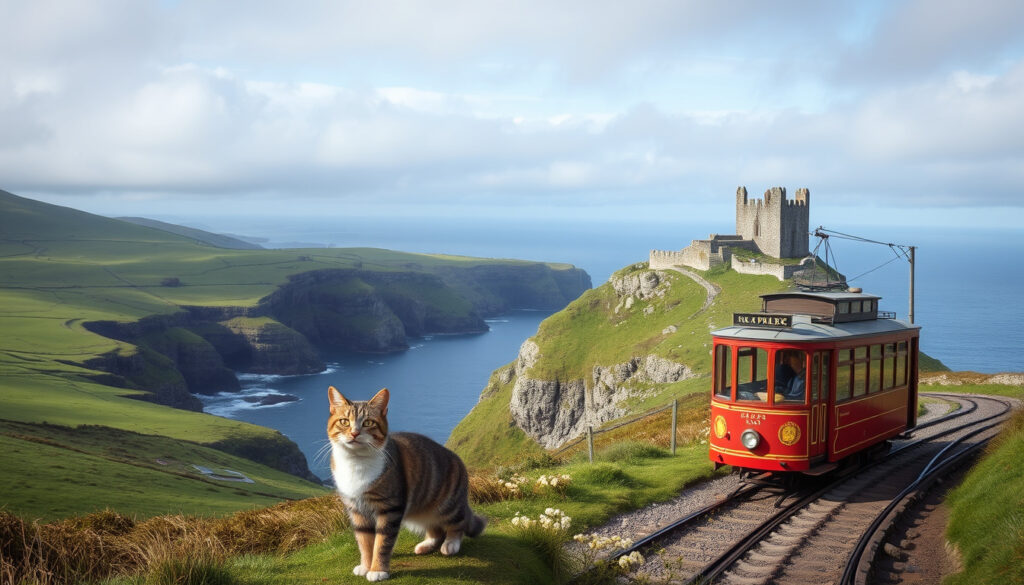
Isle of Man: Complete Travel, Living & History Guide
You’ve probably heard of the Isle of Man — maybe through the roar of the TT races, or the peculiar Manx cat without a tail. But what many people don’t realise is that this small island in the Irish Sea isn’t part of the United Kingdom or Ireland — it’s a Crown dependency with its own parliament, currency, and tax system. The island’s unique constitutional status, combined with its stunning coastline and low-tax economy, makes it a fascinating place to visit or even call home.
Area: 572 km² · Population: 84,000 (2023 estimate) · Capital: Douglas · Official Languages: English, Manx · Currency: Manx pound (1:1 with GBP) · Famous For: Isle of Man TT, Manx cat, Tynwald
Quick snapshot
- Self-governing Crown dependency, not part of the UK or EU (The Royal Family — official Crown dependencies page)
- Own parliament, Tynwald, established over 1,000 years ago (The Royal Family)
- No capital gains tax, wealth tax, stamp duty, or inheritance tax (Wikipedia — Isle of Man tax summary)
- The exact origin of the superstition against saying “rat” on the island; may stem from seafaring folklore (Wikipedia — cultural references)
- Whether the Isle of Man will ever re-join the EU is not under active consideration (Wikipedia — EU relations)
- First Isle of Man TT race in 1907 (Isle of Man TT official site)
- Tynwald gained legislative autonomy in 1866, beginning modern self-government (Wikipedia — Tynwald history)
- 2025 TT races scheduled for May–June 2025 (Isle of Man TT official site)
- Proposed public sector car travel mileage increase from 50p to 57p per mile under consideration (BBC News — Isle of Man public sector expenses)
Five key facts, one pattern: the Isle of Man blends ancient self-rule with modern tax neutrality, creating a distinct jurisdiction that operates neither as part of the UK nor as a fully independent state.
| Category | Detail |
|---|---|
| Official Name | Isle of Man (Mannin) |
| Capital | Douglas |
| Area | 572 km² |
| Population | 84,000 (2023) |
| Official Languages | English, Manx |
| Currency | Manx pound (IMP) |
Is the Isle of Man part of the UK?
What is the constitutional status of the Isle of Man?
- The Isle of Man is a self-governing British Crown Dependency, not part of the United Kingdom (The Royal Family — Crown Dependencies explanation).
- It has its own legal system, currency, and tax regime, and is not a member of the European Union (KPMG — Isle of Man overview).
- The British monarch is styled “Lord of Mann” on the island (Wikipedia — Crown Dependencies).
- The UK is responsible for the island’s defence and international representation, but the Isle of Man manages its own domestic affairs (The Royal Family).
Is the Isle of Man in the United Kingdom?
No. The Isle of Man is one of three Crown Dependencies (alongside Jersey and Guernsey) that are not part of the UK (The Royal Family). Its capital is Douglas, its area is 572 km², and its population is approximately 84,000 as of 2023 (Wikipedia — geography and demographics). For VAT purposes, the Isle of Man is treated as part of the UK, but in almost all other respects it operates independently (KPMG).
For Irish and UK citizens considering a move, the distinction matters: you won’t be moving “abroad” in the visa sense, but you will be entering a different tax and legal jurisdiction with its own rules on residency, healthcare, and social security.
The implication: living in the Isle of Man means accepting a hybrid status — closer than a foreign country, but legally distinct from the UK.
Can Irish people live in the Isle of Man?
What are the residency requirements for Irish citizens?
- Irish citizens can freely live and work in the Isle of Man under the Common Travel Area (Wikipedia — Common Travel Area). No visa or work permit is needed.
- However, those staying longer than three months must register with the Isle of Man Immigration Office (Isle of Man Government — immigration guidance).
Is it cheap to live on the Isle of Man?
Not especially cheap, but not prohibitively expensive either. According to cost-of-living data from Wise (financial services provider), a single person without rent needs about £1,053 per month, and a family of four needs approximately £3,525 per month (excluding rent). Housing and utilities are comparable to southern England. The island has no capital gains tax, wealth tax, stamp duty, or inheritance tax, and the top income tax rate is 22% as of April 2024, with a cap of £200,000 per individual (Wikipedia — tax structure). These tax advantages can offset higher living costs for high earners.
Is the Isle of Man ethnically Irish?
No. The ethnic composition is predominantly Manx (white), with significant British and Irish minorities (Wikipedia — demographics). While there is a historical Celtic connection, the island has its own distinct Manx identity and language revival movement.
What this means: for Irish citizens, the move is legally frictionless, but the cultural adjustment is real.
Why is the Isle of Man so famous?
What is the Isle of Man famous for?
- The Isle of Man TT (Tourist Trophy) motorcycle races, first run in 1907, are the island’s biggest global draw (Isle of Man TT official site).
- There is no general speed limit on rural roads, a rarity in the UK and Ireland (Wikipedia — transport).
- The Manx cat — a tailless breed — originates from the island.
- Tynwald, the island’s parliament, is the oldest continuous parliament in the world, dating back over 1,000 years (The Royal Family).
What events attract tourists?
Beyond the TT, the island draws visitors to the Laxey Wheel (a large Victorian waterwheel), the Cregneash folk museum, and its dramatic coastal scenery (Visit Isle of Man — tourist attractions). The annual Manx Grand Prix and the Southern 100 races also bring motorsport fans.
The TT alone generates tens of millions of pounds in tourism revenue each year, but the island is also quietly building a reputation as a base for financial services and e-gaming, diversifying its economy beyond tourism.
The pattern: the island’s fame rests on a mix of adrenaline and ancient tradition — a rare combination.
Was the Isle of Man ever Irish?
What is the historical connection between the Isle of Man and Ireland?
- The Isle of Man was never politically part of Ireland at any time (Wikipedia — history).
- During the early medieval period, the island experienced strong Irish and Norse influence through Celtic settlement and later Norse rule as part of the Kingdom of the Isles (9th–13th centuries) (Wikipedia — Kingdom of the Isles).
- In 1266, the Treaty of Perth ceded the island to Scotland (Wikipedia — Treaty of Perth).
- After a period of Scottish and English contest, the island came under English control by the 14th century (Wikipedia).
The implication: while the Isle of Man shares a Celtic heritage with Ireland, its political trajectory has been separate for centuries. The island’s modern identity is Manx, not Irish.
Do I need a UK passport to go to the Isle of Man?
What travel documents are required?
- British and Irish citizens do not need a passport to visit the Isle of Man, but photo ID (such as a driving licence) is required for flights (Isle of Man Government — travel advice).
- Citizens of other countries may need a UK visa, as UK visa rules apply in most cases (Isle of Man Government).
- The island has its own currency — the Manx pound — which is at par with GBP but not legal tender in the UK (Wikipedia — Manx pound).
How do I get there?
Flights operate from major UK airports and Dublin. Ferries run from Liverpool, Heysham, and Dublin (Isle of Man Steam Packet Company). The journey from Dublin takes about 2.5–3 hours by sea.
The catch: while travel is straightforward, the island’s separate currency and tax rules can catch newcomers off guard.
Timeline: key moments in Isle of Man history
- c. 6500 BC — First human settlement (Wikipedia)
- 9th century — Norse settlement; island part of the Kingdom of the Isles (Wikipedia)
- 1266 — Treaty of Perth; ceded to Scotland (Wikipedia)
- 1765 — Revestment; British Crown assumes control of customs and revenues (Wikipedia)
- 1866 — Tynwald gains legislative autonomy; modern self-government begins (Wikipedia)
- 1907 — First Isle of Man TT race (Isle of Man TT official site)
- 1973 — UK joins EEC; Isle of Man remains outside (Wikipedia)
The trajectory: from Norse kingdom to self-governing dependency, the island has always maintained a distinct path.
What’s certain and what’s not
Upsides
- Isle of Man is not part of the UK or the EU (The Royal Family).
- Irish citizens can live and work freely under the Common Travel Area (Wikipedia — Common Travel Area).
- The island is famous for the TT races, Manx cat, and Tynwald (Isle of Man TT official site, The Royal Family).
Downsides
- The exact origin of the ‘rat’ superstition (Wikipedia — cultural references).
- Whether the island will ever re-join the EU (currently no active consideration) (Wikipedia — EU relations).
- How Brexit will affect long-term trade arrangements for the island.
- The top income tax rate is 22% with a cap on total tax payable — may be subject to change (Wikipedia — tax structure).
- No capital gains tax, wealth tax, stamp duty, or inheritance tax — these policies could shift (Wikipedia — tax summary).
“The Isle of Man has the oldest representative government in the Commonwealth.”
The Royal Family — official description of Tynwald
“The Isle of Man is not part of the United Kingdom. It is a self-governing British Crown Dependency.”
The Royal Family — Crown Dependencies overview
“Wise estimates the cost of living in the Isle of Man for a single person at around £1,994 per month including rent.”
Wise — cost of living data 2025
“The Isle of Man TT is one of the most dangerous motorsport events in the world, with over 260 rider fatalities since 1907.”
Isle of Man TT official site
For anyone weighing a move to the Isle of Man, the choice is clear: if you value low taxes, a relaxed pace of life, and stunning scenery, the island offers a compelling package. But if you need fast city connections, a diverse job market, or cheap groceries, you may find the trade-off frustrating. For Irish citizens, the Common Travel Area makes relocation simple — the real question is whether the island’s unique character fits your priorities.
wise.com, iomdfenterprise.im, gov.im, en.wikipedia.org, assets.kpmg.com, gov.im, reddit.com, theblackdub.com, hr.gov.im
For those considering a move or extended stay, a detailed guide on Isle of Man covers living costs, passport rules, and the island’s unique governance.
Frequently asked questions
How big is the Isle of Man?
572 km² — roughly 33 miles long and 13 miles wide.
What currency does the Isle of Man use?
The Manx pound (IMP), which is at par with GBP but not legal tender in the UK. UK banknotes and coins are widely accepted.
Is there an airport on the Isle of Man?
Yes, Isle of Man Airport (Ronaldsway), near Castletown, with regular flights to UK cities and Dublin.
What is the best time to visit the Isle of Man?
May to September offers the mildest weather. The TT races are in late May/early June.
Can I use my mobile phone on the Isle of Man?
Yes, but roaming charges may apply if you’re on a UK or Irish plan. Check with your provider before travelling.
Are there any dangerous animals on the Isle of Man?
No. The island has no snakes, large predators, or venomous insects. The biggest risk is from adders (rare) and ticks in bracken.
Do I need travel insurance for the Isle of Man?
While UK and Irish citizens can access healthcare under reciprocal arrangements, travel insurance is recommended for cancellation, theft, and TT racing risks.
The bottom line: the Isle of Man offers a distinct alternative to both the UK and Ireland — travellers and residents must weigh its unique tax, cultural, and constitutional trade-offs.
More related posts
 St John of God: History, Miracles, and Services in Ireland
 Car Comprehensive Insurance: Ireland Coverage Guide
 Dodi Fayed: Relationship with Diana and Death
 I Bicarb Soda the Same a Baking Soda? Difference & U e
 The Social Dilemma – Summary and Fact Check
 George Pell: Biography, Conviction, Acquittal, and Death
 Happy Gilmore 2 Reviews: Hit, Flop, or Underrated?
 Sam Ibrahim: Biography, Business, Philanthropy and Media